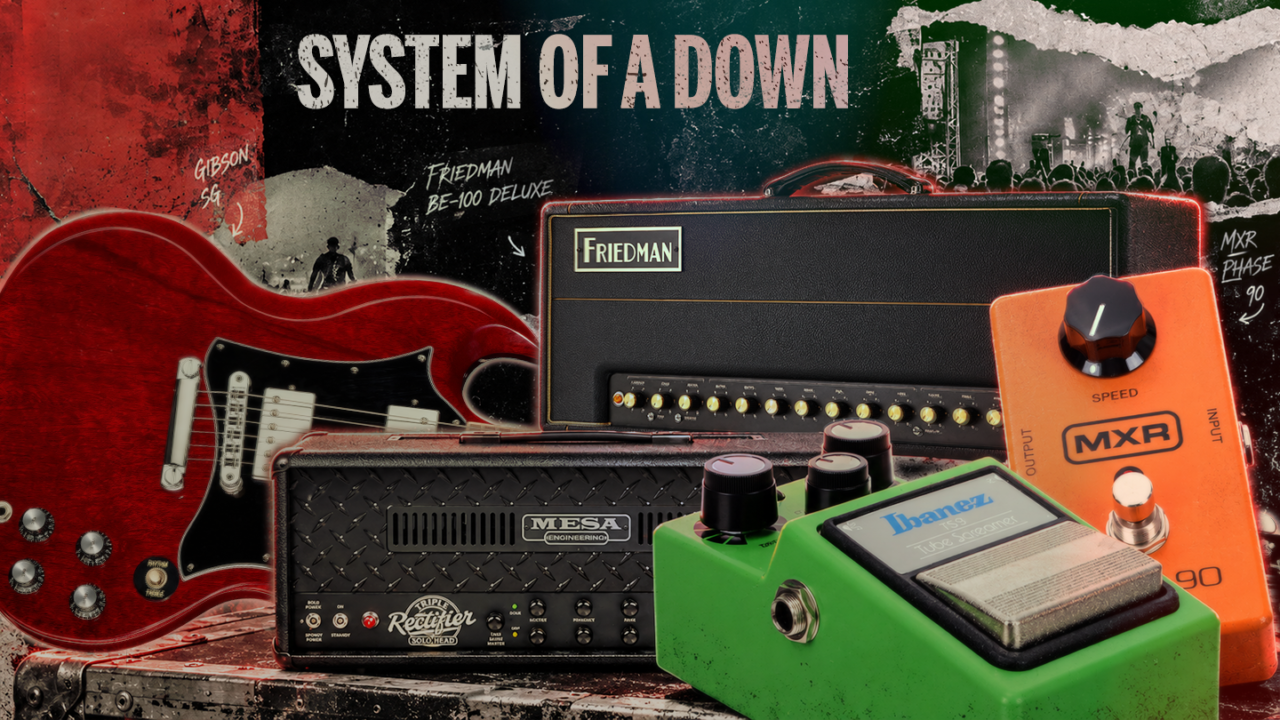
What other metal band could fill the Stade de France twice (160,000 people, no less!) without having released an album in twenty-one years? Yet that’s exactly what System Of A Down have just done, for a series of unforgettable dates with Queens Of The Stone Age as very special guests. When it comes to guitar tone, the recipe behind Daron Malakian’s unmistakable sound has barely changed since the first album in 1998. To celebrate this landmark tour, we’re taking a look at the key ingredients that make up the SOAD sound.
Consistency
System Of A Down are a model of consistency in more ways than one: the band’s line-up hasn’t changed since 1997, with singer Serj Tankian, guitarist Daron Malakian, bassist Shavo Odadjian and drummer John Dolmayan. The four Los Angeles musicians have remained just as steadfast in their beliefs: championing the Armenian cause, denouncing the prison system and the hypocrisy of the war on drugs in the USA, and speaking out against the fundamental injustice of war. Above all, though, the band have always released excellent albums, with a flawless five-album discography (which could have been three, but we’ll come back to that). Across all these records, you’ll find the same skilful blend of huge metal riffs, soaring choruses, odd time signatures, unlikely harmonies and Middle Eastern sounds. With more than 12 million albums sold, it’s fair to say that SOAD’s music has transcended genre boundaries to reach a truly mainstream audience.
Despite this extraordinary diversity, Daron Malakian’s approach has always remained remarkably simple. He essentially uses two sounds: a clean tone that is never quite clean, and a huge distorted tone combining the thickness of classic rock with the chug of nu metal. Very few effects, no modelling: just amps and attitude!
As for tunings, the first three albums are in Drop C (low to high: C G C F A D), while the final two are in Drop C# (C# G# C# F# A# D#). This is one of the reasons why he switched from 10-52 to 10-50 strings, always from Ernie Ball.
The Spark
In SOAD’s early days, Daron mainly played a black Fender Stratocaster. Surprisingly, the first demos and early gigs were done with a Strat in the standard three-single-coil configuration, which might seem a little lightweight for the band’s material. Amp-wise, he was using a Carvin X-100B at the time, a choice probably driven more by budget than tone.
In 1997, when Rick Rubin signed the band and they received their first advance, they bought new gear to record their debut album. Legend has it that Malakian went to the Guitar Center store on Sunset Boulevard and instantly fell in love with the shape of the Ibanez Iceman, which he felt looked different enough from everything else to make it his own.
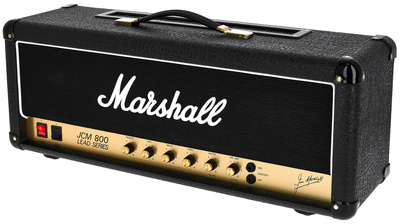
However, a large part of the album was recorded with a Fender Stratocaster Big Apple, a model released just a few months earlier and distinguished by its two humbuckers: a Seymour Duncan Pearly Gates in the bridge and a ’59 in the neck. As for amps, the self-titled debut was recorded using a blend of two classics: a Marshall Super Lead for thickness and a JCM-800 for bite and punch. And to smooth out the attack of both, an Ibanez Tube Screamer.
On The Road Again
Following the album’s release, SOAD quickly started turning heads and toured with the likes of Slayer, Sepultura and Fear Factory before becoming a headline act in their own right. By 1999, Malakian had fully embraced the Iceman, playing several different versions, including black and silver sparkle finishes. He was also seen with the ICX, an Iceman with a more compact body that would inspire his signature model in 2004, a rarity limited to just 300 examples.
As for amps, he followed the trend of the time with the ubiquitous Mesa Boogie Triple Rectifier, which would remain a cornerstone of his approach until 2005. Finally, Malakian’s live setup from this period is also notable for its complete lack of effects, apart from a Boss tuner that wasn’t even on stage!
Double Helping
When SOAD entered Cello Studios in Hollywood to record their second album in the spring of 2001, they were looking to broaden their sonic palette. Daron Malakian therefore equipped himself with several guitars that gave him access to richer textures than his Strat and Iceman could provide. He brought along baritone Icemans, a Gibson SG, a Les Paul used mainly for metal riffs, a Gibson Firebird, a white Jackson Randy Rhoads with a fixed bridge and sharkfin inlays, and even a Gibson EDS-1275, the famous double-neck SG in a white finish.
The result remains the band’s best-selling album to date, Toxicity, a landmark record from which they play no fewer than 10 of the original fourteen tracks on their current tour. The sessions proved so intense and creative that SOAD recorded more than thirty songs for the album, with the surplus eventually becoming Steal This Album! in 2002.
To recreate the album’s more varied and complex textures on the subsequent tour, Malakian barely changed his setup: he simply added two Line 6 multi-effects pedals, the MM-4 for modulation and the DL-4 for delays.
Double Vision
The same level of productivity can be found in the sessions that produced the final two albums: although Hypnotize and Mezmerize were released six months apart in 2005, they were recorded during the same sessions and effectively form a double album.
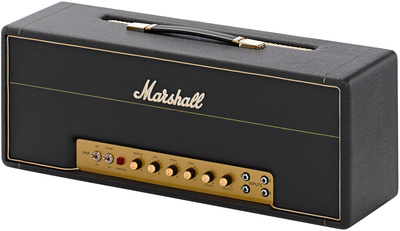
Malakian’s sound changed slightly during this period, becoming even thicker and deeper. This was when he adopted a 1970s Marshall JMP 100-watt head modified by Dave Friedman. It was also when he fell in love with two vintage guitars that remain his favourites to this day: a 1962 Gibson SG Standard (from the period when the SG was still called the Les Paul) and a 1968 ES-355.
It was therefore only natural that he was seen playing SGs extensively on the subsequent tour, including two ’61 Reissue models, one red and one white.
The End Of The Road?
In 2006, internal tensions finally brought the band as it had existed up to that point to a halt. Malakian then turned his attention to his own band, Scars On Broadway, having already handled half of the vocal parts on SOAD’s final two albums.
But the prospect of a reunion has resurfaced several times since, beginning with their first live reunion in 2011. For the current 2025-2026 tour, Malakian hasn’t fundamentally changed the way he operates, although he has treated himself to some rather impressive toys. His guitars are all black custom creations with gold hardware, including two Gibson Custom Shop SGs (one with a Vibrola without the arm, the other with a sideways vibrato), a Flying V with a Les Paul Custom headstock, two ES-355s (one with a gold pickguard, the other with a black pickguard and three pickups, both with sideways vibratos) and, of course, Ibanez Custom Shop Icemans, including a black model with black binding whose Vibrola is purely decorative. His pickups are generally Seymour Duncan Pearly Gates or Saturday Night Specials.
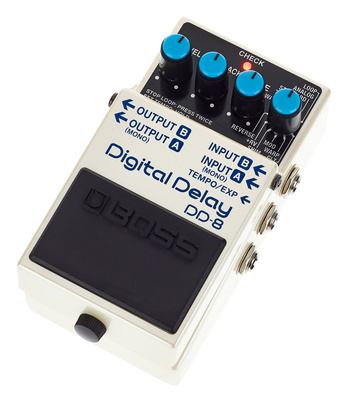
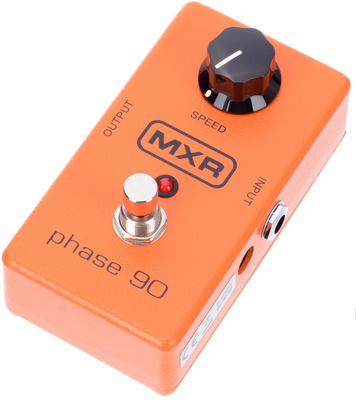
As for the rest of the rig, amps are still very much part of the equation, with two pairs of Friedmans, BE-50 Deluxe and BE-100 Deluxe models controlled by a Voodoo Lab Ground Control Pro foot controller. When it comes to effects, minimalism still rules, with just two pedals you may already own: a Boss delay and an MXR Phase 90 phaser.
SOAD will be appearing at a festival in Texas in October, and as things stand, it is their final scheduled date. There’s no telling when they’ll be back after that, but one thing is certain: we’ll be there!
This article is an adaptation of a piece originally written by Julien Bitoun, who is credited as the author of the original French t.blog article.



Comments 0
No comments yet.