




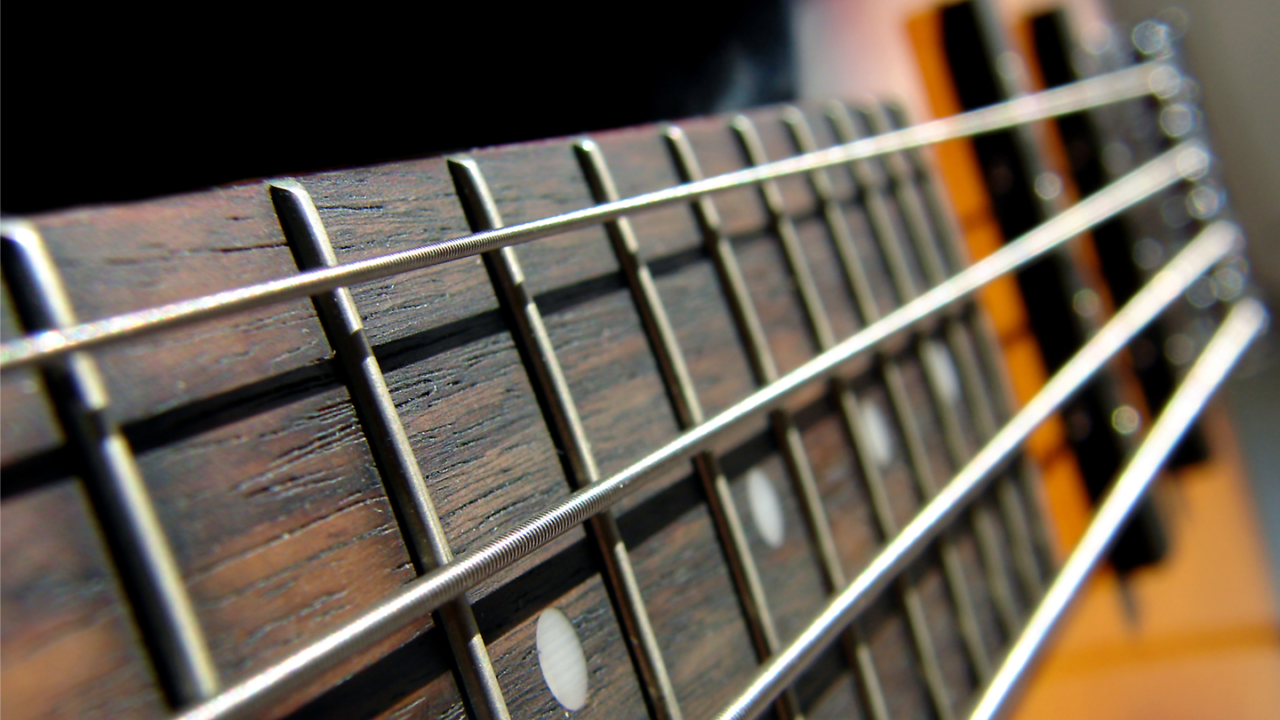

For many bass players, strings are still merely a means to an end – something they usually only pay attention to once they’ve snapped or become very dirty. Yet choosing the right strings can make a huge difference in the quest for the perfect sound.
How do different strings affect the bass sound?
On an electric bass, the strings are the link between you and your instrument. So it shouldn’t come as a surprise that they have a decisive influence on the overall sound. The material and texture of the strings not only affect how they feel, but also how they interact with the magnetic field of the pickup. This has a direct impact on the volume, attack, sustain, and frequency response of the instrument.
Even small differences in your choice of strings can alter the character of your bass from mellow to punchy, from warm to assertive, or from dark to crisp. Find out in our guide how string gauge, winding material and coating affect the sound.

Which Strings are Best for my Bass and me?
Choosing the right bass strings is anything but easy these days. Due to different materials, gauges and manufacturing methods, strings can differ quite significantly in terms of sound, feel or lifespan. Which option suits you best therefore depends on your personal sound preferences, your instrument and, last but not least, your budget.
To help you compare the different options, this guide explores various string types using examples from the current D’Addario range. We’ve also included some interesting alternatives for those on a tighter budget.

Gauge
The gauge (thickness) of bass strings is usually specified in thousandths of an inch. The designations ‘.040’ or ‘.100’ therefore refer to diameters of 0.04 and 0.1 inches respectively. String sets are often named after the gauge of their G string (e.g. .050 electric bass strings) or categorised as light, medium, or heavy. Here’s a rough overview of common bass string gauges, using the D’Addario EXL series as an example. Of course, there are also many variations, such as string sets with intermediate gauges, thicker bass strings or extra-thin G and D strings; not to mention string sets for 6-string basses or acoustic basses. Before you choose your preferred string gauge, you’ll also need to determine whether you have a short-scale or long-scale bass.
| D’Addario EXL Series | G | D | A | E | B |
| Super Light | 040 | 060 | 075 | 095 | 125 |
| Regular Light | 045 | 065 | 080 | 100 | 130 |
| Medium | 050 | 070 | 085 | 105 | 135 |
| Heavy | 55 | 75 | 90 | 110 |
Thin bass strings (.040 sets) are easier to fret and are particularly well suited to beginners as well as to specific playing techniques such as slap bass or tapping. They sound slightly brighter and sharper than thicker strings and have a faster response when plucked.
Medium-gauge strings (.045 sets) are considered the ideal compromise between attack and sustain, delivering a very balanced tone across the entire frequency range. They can be described as all-rounders suitable for many musical styles.
Thicker bass strings (.050 sets) sound particularly punchy and warm and, for physical reasons, have a longer sustain (the decay of the notes). Fans of lower tunings or drop tunings often opt for thicker strings to prevent the dreaded buzzing caused by reduced string tension. Some manufacturers use a tapered winding at the ball end for particularly thick strings (e.g. the B string on a 5-string bass), a technique known as ‘taper wound’.
An ideal starting point for further experiments: .045 electric bass strings

Material
Like electric guitar strings, electric bass strings consist of a steel core wrapped in another wire (winding wire). Both the material and the structure of this design have a major influence on the string’s vibrational behaviour and magnetic properties – and therefore on your sound.
Nickel-steel
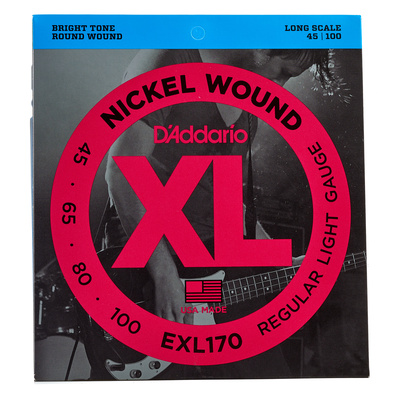
Nickel-plated steel (also known as nickel-wound) is considered the tried-and-tested standard material for bass strings and offers a good balance of warmth, brilliance and volume. If you’re buying new bass strings for the first time, this is the place to start.
The all-rounder: Nickel-plated steel

Stainless Steel
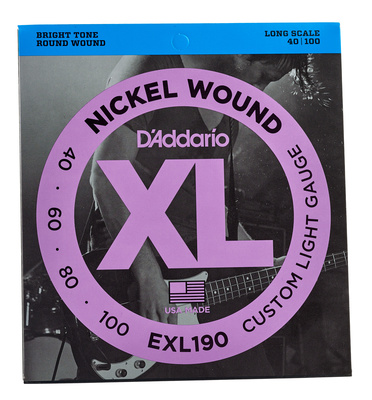
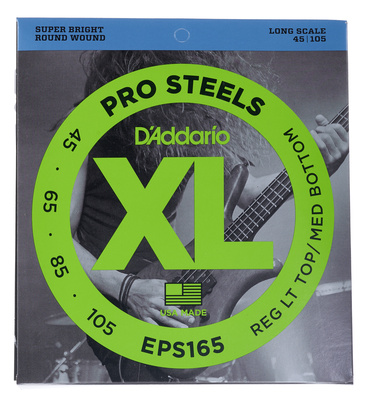
Stainless steel strings (also known as Pro Steels) are made from a stainless steel alloy and are more resistant to dirt build-up and corrosion than nickel-steel strings. They are considered louder, more assertive, and more prominent in the high frequencies. Many bassists describe their surface as rougher and harder.
High output and long-lasting: Stainless Steel strings
Daddario
EPS165
Premium bass strings
Alongside their standard nickel-steel strings, manufacturers such as D’Addario offer high-quality alternatives featuring an extra-hardened steel core and newly developed winding alloys. The NYXL series promises maximum durability and tuning stability with greater projection in the high and low frequencies. However, this does come at a slightly higher price.
Premium strings with that little bit extra: the NYXL series

Daddario
NYXL45105 Bass Set
Coating and Surface Finish
Besides the material, the texture of the string’s surface also has a major influence on the sound of your bass string, as well as on your personal playing feel. Special coatings or surface treatments can also significantly extend the string’s lifespan.
Coated Strings
Coated strings are a relatively recent yet highly successful trend in the strings market. During manufacture, the string is coated with an ultra-thin polymer film, which makes it significantly more resistant to sweat, dirt build-up, and corrosion. Coated strings sound slightly rounder and softer than new nickel-steel strings, but retain their tonal characteristics for a longer period thanks to the surface treatment.
Consistent tone with a long lifespan: coated bass strings
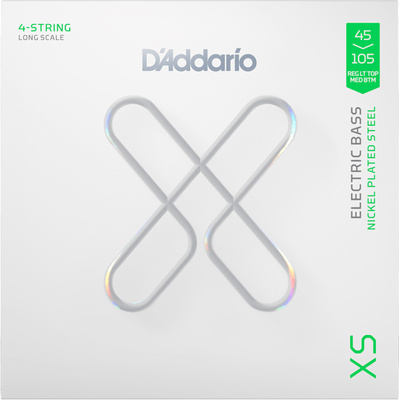
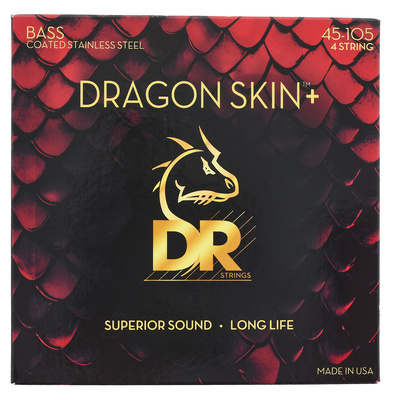
Coated strings don’t always have to be expensive:
Flatwounds
Unlike the more common roundwounds, flatwound strings for electric bass are wound with a flat wire, giving them a smooth surface. This minimises slippage noises when changing frets and prevents dirt build-up. Flatwounds generally sound warmer and more muffled than regular strings; due to their construction, they have slightly less sustain and are particularly well suited to vintage sounds.
Half-wounds
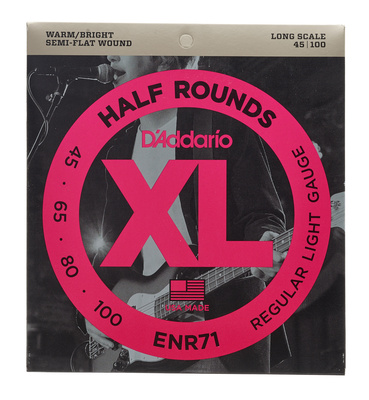
Half-wound strings are sanded down after being wound with a round wire and are regarded as a compromise between flatwounds and roundwounds. D’Addario markets these strings under the name ‘Half Rounds’.
Achieve a vintage sound with smooth strings: Half Rounds
Daddario
ENR71
Which Bass Strings are right for me?
Unfortunately, only you can answer the question of which strings are the perfect fit for you and your instrument. If you’re not yet sure which type of strings suit you best, you can’t go wrong with a set of .045 nickel-plated steel strings to start with. If you’re having problems with strings snapping or your bass not cutting through the mix, stainless steel strings or the D’Addario NYXL series might be the right choice for you.
If you want to play your strings for a long time without compromising on sound quality, it might be worth switching to coated strings. And if you find that your bass sounds a bit too sharp and overpowering, this might be your introduction to the world of flatwounds.
Bass Strings: Your Feedback
Which type of string has worked best for your instrument so far? Feel free to let us know in the comments.














Comments 0
No comments yet.