






For many electric guitarists, strings are just a consumable item that is sometimes given little thought. Yet the strings can make all the difference when searching for your dream sound.
Why are electric guitar strings so important?
On an electric guitar, the string forms the direct link between your fingers and the pickup, and has a major influence on the overall sound. Factors such as gauge, texture and material not only affect how the guitar feels when you play it. The volume, attack, sustain and overall frequency response of your instrument also depend heavily on the strings. Even the slightest differences can determine whether your electric guitar sounds warm and rounded or aggressive and assertive. But how do gauge, material and coating influence the sound?

Which strings are right for me?
There’s a huge range of electric guitar strings available, each with very different characteristics in terms of tone, feel and durability. Which string suits you best depends on your personal playing style, your tonal preferences and, of course, your budget.
D’Addario has been one of the leading manufacturers of guitar strings for more than 50 years and has played a key role in countless innovations in materials and manufacturing techniques over the past few decades.
To help you compare the different types of strings more easily, we’ve supplemented this article with examples from the current D’Addario catalogue and a few budget alternatives.
Gauge
String gauge is almost always specified in inches; more precisely, in thousandths of an inch. So if you come across designations such as ‘.009’, ‘009’ or simply ‘9-gauge string’, this refers to a diameter of 0.009 inches. String gauge plays a crucial role in your personal playing feel, but it also affects the overall sound of your guitar.
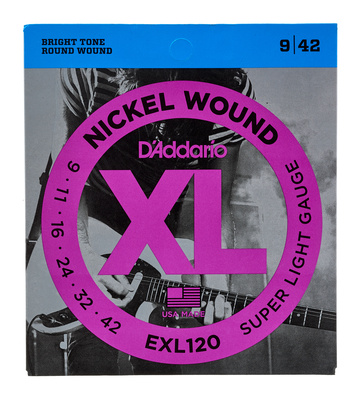
Thin strings (e.g. .008 sets) are considered particularly easy to fret and, to many guitarists’ ears, sound slightly more defined in the high frequencies. However, this may mean compromising on tuning stability. Thicker strings (.010/.011 sets) produce slightly more volume in the bass frequencies and are considered to be more durable and resilient. They are particularly well suited to a harder strumming style or lower tunings. Most guitarists use .009 gauge sets (e.g. 009, 011, 016, 024, 032, 042) or .010 gauge sets (e.g. 010, 013, 017, 026, 036, 046). For fans of drop tuning, there are also hybrid string sets with reinforced bass strings (e.g. 10 to 52).
Ideal for beginners: a 9-gauge electric guitar set:

Material
Electric guitar strings consist of a steel core – often with a hexagonal cross-section – which, in the case of wound strings, is wrapped in an additional wire. The material of this winding has a decisive influence on the sound of the guitar, as it significantly affects the magnetic properties of the string.
Nickel-plated steel
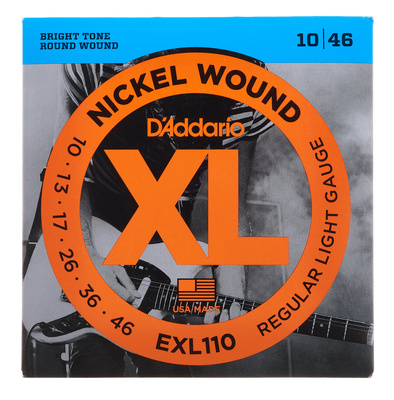
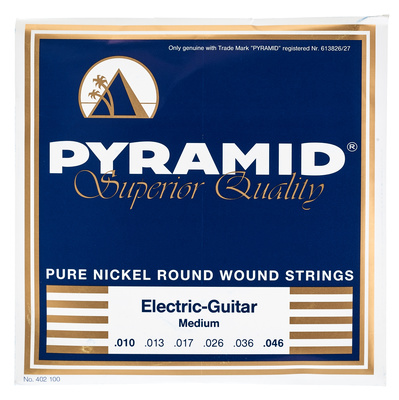
Nickel-plated steel wire has been regarded as the standard material for electric guitar strings for many decades. For most guitarists, the magnetic properties of nickel-plated steel offer the perfect balance of volume, warmth and brilliance. The same applies to the feel when playing bends and slides.
The perfect all-rounder: nickel-plated steel
Pure Nickel
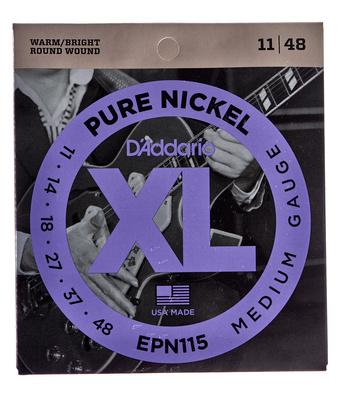
High-nickel alloys are less magnetic than nickel-steel and therefore produce a slightly softer and warmer tone. They are popular with guitarists looking for a less aggressive vintage sound.
A softer tone for vintage enthusiasts: Pure Nickel
Daddario
EPN115
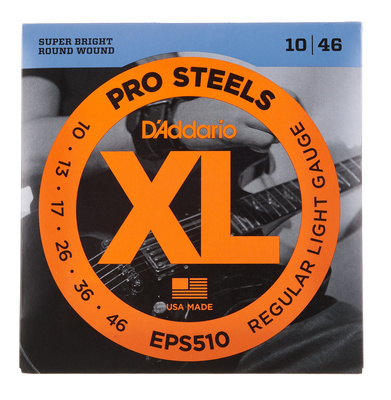
Strings made from stainless steel produce a particularly high output level and are considered direct, brilliant and assertive. When playing, many guitarists find them smoother, harder and less ‘bendy’.
Full steel power for assertive sounds: Stainless Steel
Daddario
EPS510
Premium strings
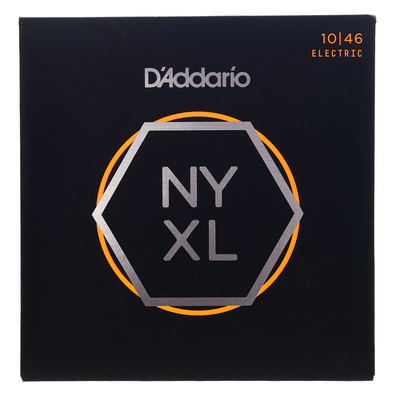
Some manufacturers, such as D’Addario, offer electric guitar strings with a particularly robust core made from high-quality steel. Premium strings such as the NYXL series promise a significantly longer lifespan, greater output and presence, but also cost more than standard strings.
Premium strings with a long lifespan and greater presence: the NYXL series
Daddario
NYXL1046
Surface and coating
Besides the material of the string itself, the nature of the surface also plays a crucial role in the sound and feel of an electric guitar string. Furthermore, the lifespan can be significantly extended by treating the surface structure appropriately.
Coated strings
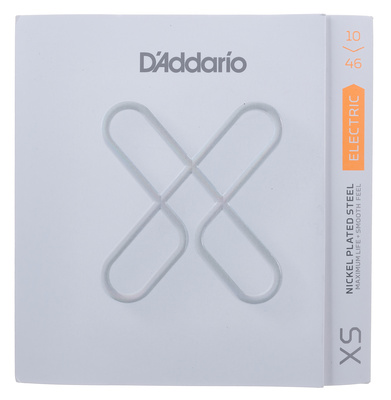
In the world of acoustic guitars, coated strings have long been regarded as the ultimate in durability and brilliant sound. With electric guitar strings, too, a film coating on the string surface can extend the string’s lifespan, counteract dirt build-up and reduce slapping noises. D’Addario has developed two different processes for this purpose, designed to guarantee maximum durability (XS series) on the one hand, and a familiar playing feel (XT series) on the other.
Durable and with a particularly brilliant tone: coated strings
Daddario
XSE1046
Coated strings don’t have to be expensive:

Harley Benton
Coated Electric Guitar 009
Flatwounds/Halfwounds
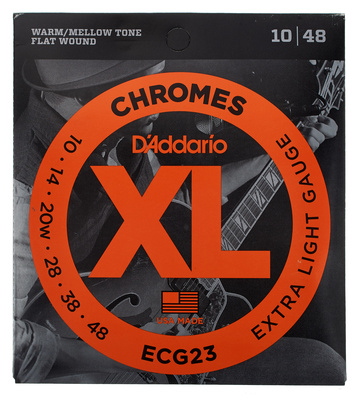
Flatwound strings (also known as polished strings) are wound with a flat wire, unlike regular roundwound strings, and have a particularly smooth surface. They are therefore significantly less prone to dirt build-up and sound warmer and more mellow than unpolished strings. D’Addario’s so-called ‘Half Rounds’ offer a compromise to the much more widely used roundwound strings; in these, the round winding wire is subsequently sanded smooth.
A distinctive vintage sound with long-lasting durability: flatwounds
Daddario
ECG23
Which type of string suits me best?
Ultimately, you’ll just have to find out for yourself which strings work best with your playing style and sound preferences. If you’re having problems with strings breaking, it often helps to increase the gauge or switch to more durable strings (e.g. stainless steel, NYXL). If your sound lacks presence and punch, thinner or coated strings may be the solution. And if you fancy trying something completely new, you might find that polished flatwound strings are just the ticket.
Do you have any questions about the right strings for your electric guitar? The specialists in our guitar department will be happy to help. Simply click the ‘Need help?’ button on a product page in our shop or contact our customer service team via this website to arrange a phone appointment. We’d also be happy to call you back. And of course, we always look forward to seeing you at our shop in Treppendorf, where you can speak to our staff in person!
Feedback: Electric Guitar Strings
Have you found the perfect strings for you yet? Let us know in the comments.














Comments 3