
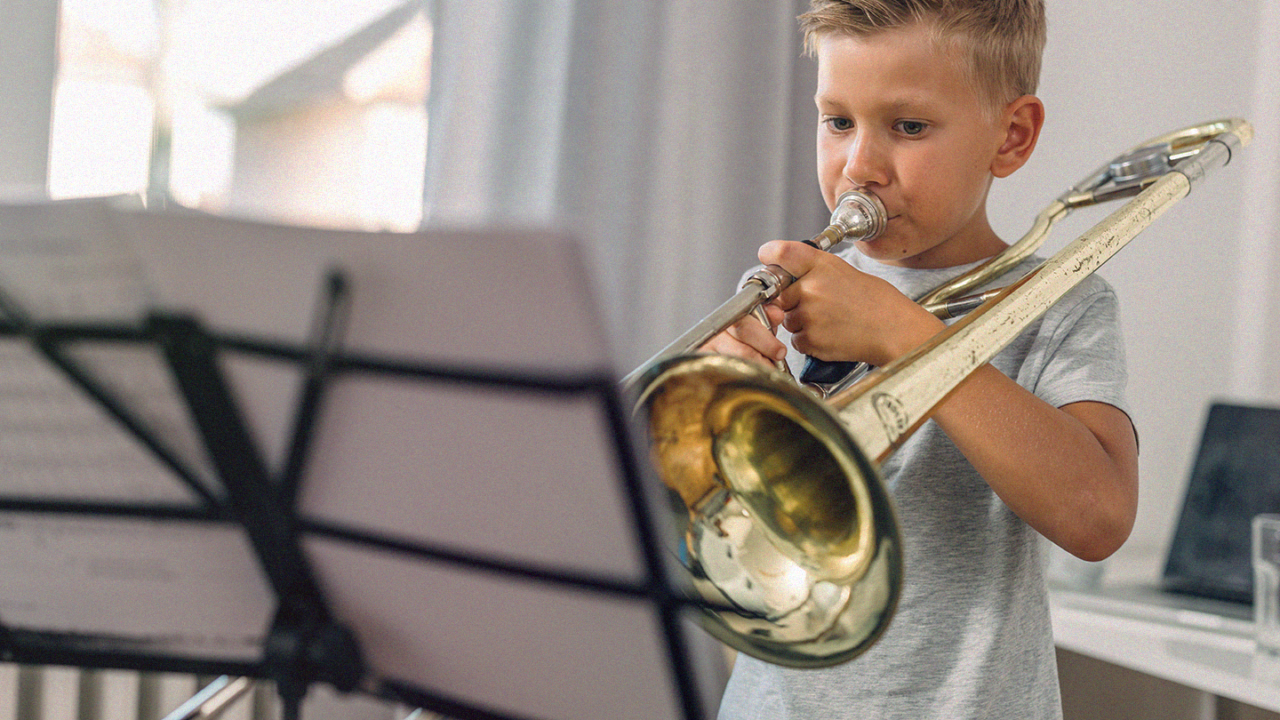

All three of these instruments belong to the brass family, yet they could hardly be more different. Their sound, playing style and use in music vary significantly. Find out which of these instruments is the best fit for you or your child!
| Instrument | Character |
| Trumpet | It is bright, brilliant and assertive and ideal for melodies and solos. |
| Trombone | It has a powerful, warm sound and is played with a slide instead of valves. |
| Euphonium | It sounds soft, full and voice-like and is often referred to as the ‘cello of brass instruments’. |
The trumpet: the most popular brass instrument of all
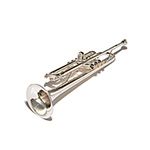
The trumpet is arguably the most commonly played brass instrument, which clearly underlines its popularity. Its bright, brilliant and yet assertive sound has secured it a leading role in a wide variety of genres, from jazz and pop to brass bands and classical music. Thanks to its tonal qualities, it is equally at home in big bands and church music as it is in orchestras and smaller ensembles. The trumpet scores highly for its great flexibility, being used both in the wind section and as a solo instrument. Compared to its two brass relatives, it is relatively lightweight, yet – curiously enough – all the more assertive in terms of volume.
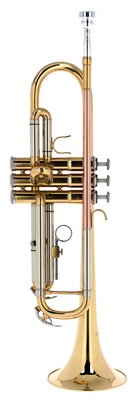
Startone
STR 25 Bb-Trumpet
So what’s the best age to start playing the trumpet? As a rule of thumb, children can start from around seven to eight years old, sometimes even a little earlier. However, it makes sense to wait until the front incisors have come through. Furthermore, the child should be physically up to the task, as the instrument requires a good amount of air, breathing technique, and stamina.
Types of trumpet
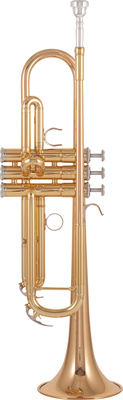
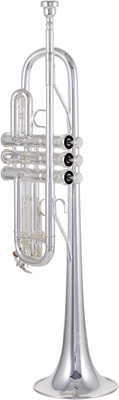
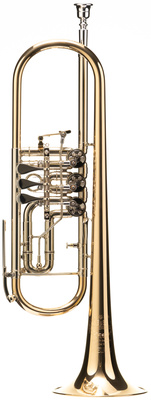
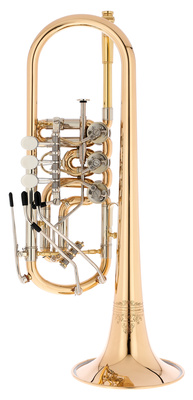
If you’re looking for a trumpet that matches your expectations, you’ll come across a variety of different designs. For instance, there are Bb and C trumpets fitted with Perinet valves, as well as Bb and C trumpets with the more complex rotary valves. Instruments with Perinet valves offer greater flexibility in tone and expression and, to a certain extent, conform to the typical American sound ideal. Rotary-valve trumpets are more commonly found in symphonic music and follow the German sound ideal. However, ‘bending’ notes is harder on them.
Friedrich Hofmeister Verlag
Arban Schule für Trompete
In addition, there are the bright, high-pitched piccolo trumpets, which, due to their tonal range and the extremely close spacing of notes, are more difficult to play and certainly cannot be classified as instruments for beginners. To avoid any confusion: these have nothing to do with pocket trumpets, which are often used as travel instruments.
Trombone: unique sliding mechanism
The biggest difference between the trombone and the trumpet and euphonium is the way the sound is produced. As with the other brass instruments, this involves the mouthpiece, the embouchure, and the air column. In the case of the slide trombone, however, the pitch is determined using the slide, with a standard trombone having seven main slide positions. As the slide does not click into place and glides smoothly, the positions are seamless, allowing for the characteristic glissando effects. It is interesting to note in this context that many notes can be played in more than one position; these are then referred to as auxiliary positions. By making use of these alternative positions, you can play fast passages far more fluently.
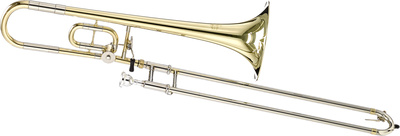
Thomann
TF-300 Junior Trombone
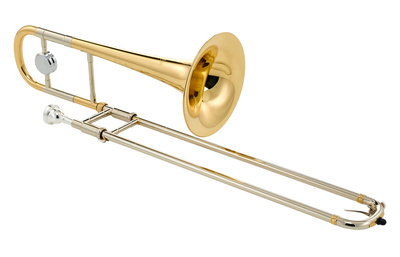
The trombone’s range of use extends from traditional brass band and sacred music through jazz in a wide variety of line-ups to the classical symphony orchestra. It is also occasionally found in popular music, for example in ska. Although the trombone is considered one of the oldest orchestral instruments in the world, it has lost none of its popularity. With a valve trombone – which, as the name suggests, has three or more valves – achieving correct intonation is much easier, particularly for beginners. However, the tonal character is also significantly less varied. Trombones designed specifically for children, which are smaller in size and lighter in weight, are also available.
Types of trombone
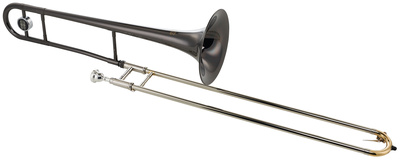
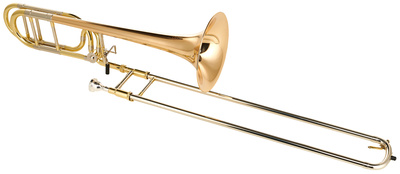
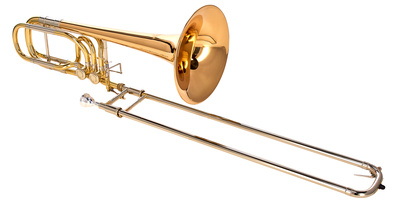
Naturally, there are also different types of trombone. These relate primarily to pitch, with the tenor trombone being the most commonly played and best-known, followed by the alto trombone, the bass trombone and other specialised variants.
Some tenor trombones have a specific feature that we should take a closer look at. Before purchasing, determine whether the instrument has a so-called fourth valve (F attachment) or not. This can offer significant advantages when playing. Firstly, it extends the range, closing the gap between the low E and the pedal B in the low register. Furthermore, the fourth valve reduces the distance required to grip or move the slide, making it significantly easier to reach difficult slide positions or switch between them. Ultimately, this means the slide needs to be moved less in the lower registers, which makes things a great deal easier. Incidentally, a fourth valve does not turn the trombone into a valve trombone, although such models do exist.
Euphonium: the ‘cello’ of the brass family
The euphonium is particularly notable for its soft, rounded and exceptionally melodious tone. While it is comparatively heavy – ranging from around 3.5 to 4.0 kg for standard models and approximately 4.5 to 5.1 kg for versions with compensation for improved intonation –, learning and playing the instrument is undoubtedly easier than the trumpet. As a beginner, you should simply possess the physical strength to hold the instrument properly – although, considering its weight, one might almost describe it as ‘hoisting’ it.
Thomann
Little Lion Bb-Baritone
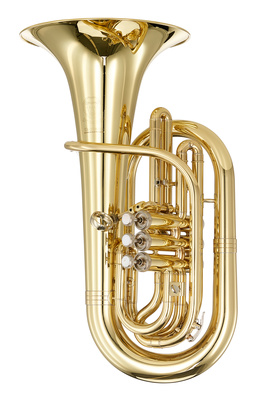
However, so-called compact models are also available, meaning that children can learn to play the euphonium too. For example, the Thomann Little Lion Bb baritone, which was developed specifically for children, weighs in at just around 2.6 kg. Still, the euphonium is less suitable for younger children, but perfectly fine for teenagers.
Types of euphonium
When it comes to euphoniums, a distinction is primarily made between two variants: the so-called standard euphoniums and euphoniums with compensation. Fundamentally, the instrument is regarded as the melodious little sister of the tuba, but it also suffers from physically inherent problems, particularly the issue of correct intonation – or the need to correct it – in the lower registers.
The crux of the matter here is the considerable length of the tube, which results in a particularly long air column. With a well-developed embouchure, focused attention on pitch and plenty of practice, this can be mastered, although it is by no means easy. And this is precisely where the compensation mechanism comes into play. This sophisticated system involves a fourth valve that serves as an intonation aid for notes in the low register.
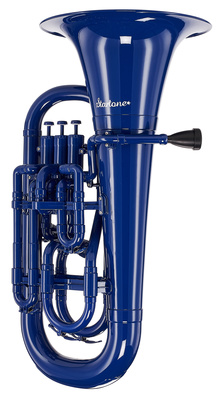
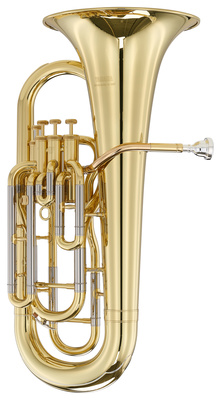
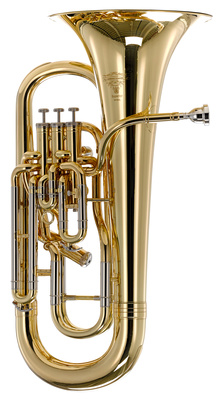
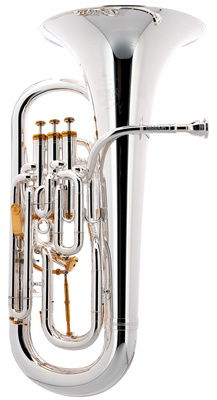
Here are the differences at a glance:
| Criterion / Instrument | Trumpet | Trombone | Euphonium |
| Sound | bright and brilliant | warm and powerful | soft and full |
| Difficulty | medium | medium | easy to medium |
| Playing technique | valves | slide | valves |
| Volume | high | medium to high | medium |
| Weight | light | medium | heavy |
| Portability | very good | good | limited |
| Styles | classical, brass music, jazz, pop | classical, brass music, jazz, big band, ska | Brass music, classical |
| Suitable for children? | yes | yes, using a children’s trombone | yes, using children’s or compact models |
Back 2 School
You’re really eager to learn an instrument, but you’re unsure which one suits you best? Whether you are a complete beginner or getting back into it after a break, our “Back 2 School” campaign is here to help you find the right instrument.
Discover our
👉 Back 2 School selection 👈
Trumpet, trombone or euphonium: your feedback
We’re keen to find out which instrument you’ll choose or have already chosen. Feel free to let us know in the comments!



Comments 0
No comments yet.