


1010music nanobox lemondrop

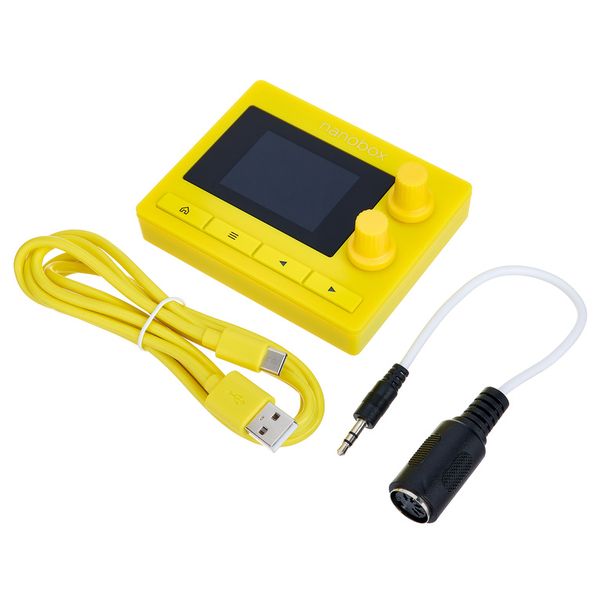


Polyphonic Granular Synthesizer
- Compact desktop design
- 2 granulators and an additional oscillator
- 4-voice polyphony
- 2 multimode filters, 2 envelopes, 2 LFOs and a modulation sequencer
- Controllable via MIDI for real-time sound manipulation
- 6 effects: flanger, distortion, chorus, phaser (FX1), delay and reverb (FX2)
- 2" touch screen
- 2 encoders and 4 control buttons
- Over 100 presets and WAV files (on the microSD card included)
- Supports WAV import via microSD card
- Power supply via USB-C
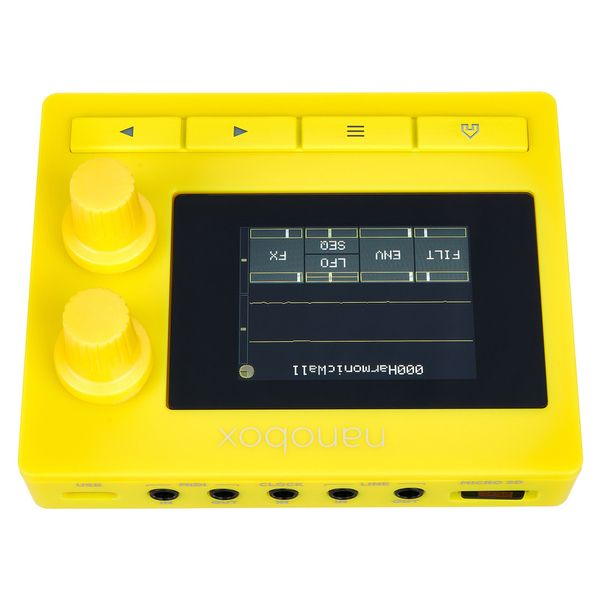
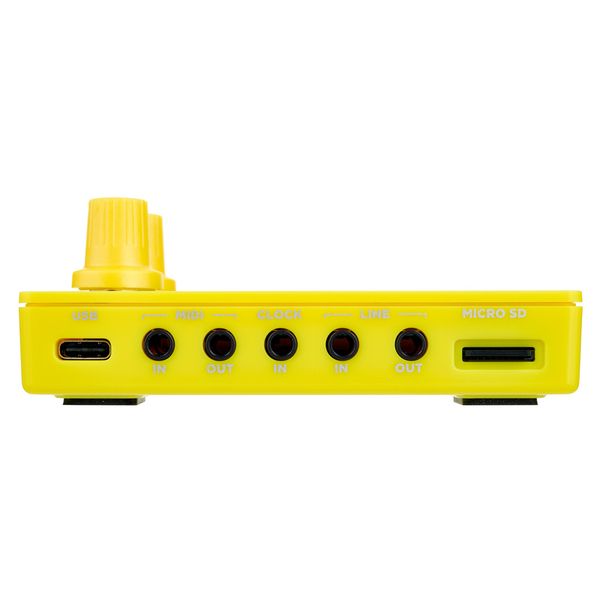
- 1 MIDI in/out: 3.5 mm jack
- 1 Clock In: 3.5 mm jack
- 1 Line In/Out: 3.5 mm jack
- 1 USB-C connection
- 1 MicroSD card slot
- Dimensions (W x D x H): Approx. 95 x 76 x 38 mm
- Weight: 112 g
- Incl. USB-C to USB-A cable, MIDI adapter, microSD card, quick-start guide
-
Available since February 2022
-
Item number 536616
-
Sales Unit 1 piece(s)
-
Design Desktop
-
Polyphony 4
-
Sound Generation Digital
-
MIDI interface 1x In, 1x Out
-
Storage Medium MicroSD
-
USB-port Yes
-
Effects Yes
-
Arpeggiator No
-
Number of Analog Outputs 2
-
Digital Output Yes
-
Display Yes
-
Optional Expansions N/A
-
Special Features Compact Desktop Design
-
Where soundscapes melt like lemondrops
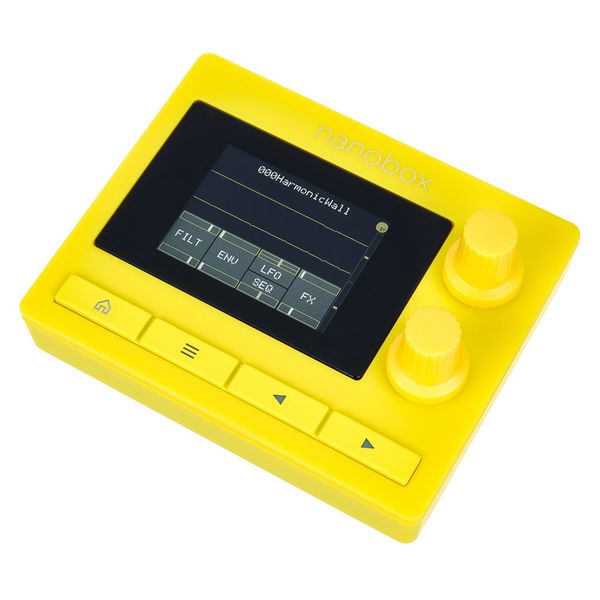
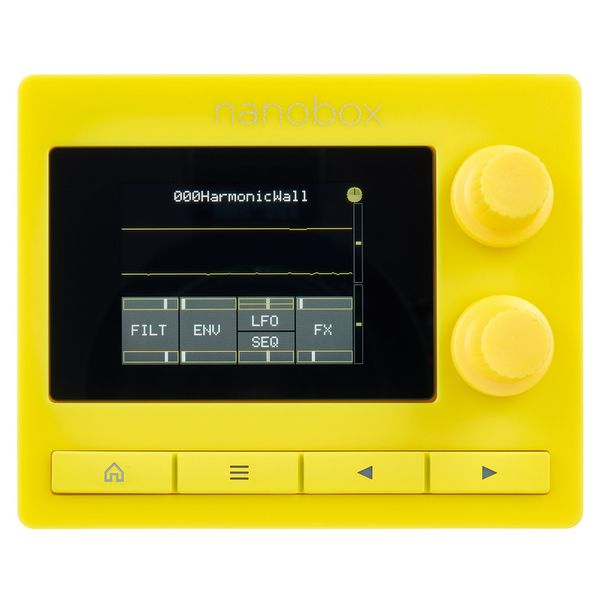
The bright yellow 1010music Nanobox Lemondrop is probably one of the smallest desktop synthesizers out there. It's a 4-voice polyphonic synth that uses granular synthesis to create its sound. Unlike its sibling, the Nanobox Fireball – which is a wavetable synth – it can granulate two distinct audio sources simultaneously, either from .wav files stored on the pre-installed SD card or from an external source (or a combination of both). Plus, it offers access to even more grain parameters for deeper, more detailed sound design. Creative musicians can sculpt their sound using the two multimode filters, two envelopes, and two LFOs. The Lemondrop also has a modulation sequencer to really breathe life into patches, samples, and textures, not to mention the six built-in effects. It's also not much larger than a pack of cards, so it is literally pocket-sized – combining refined ergonomics with impressive creative potential.
)
Complex granular synthesis in a compact device
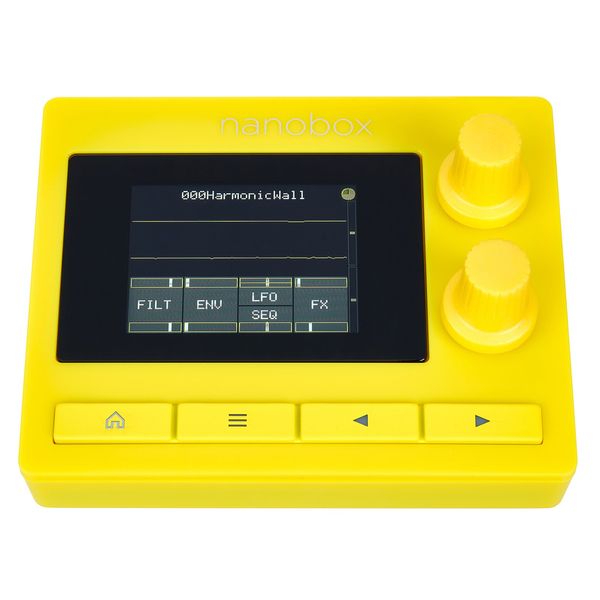
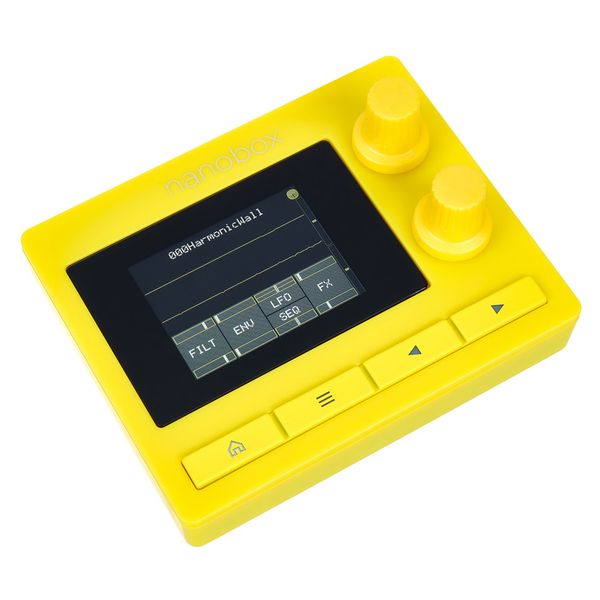
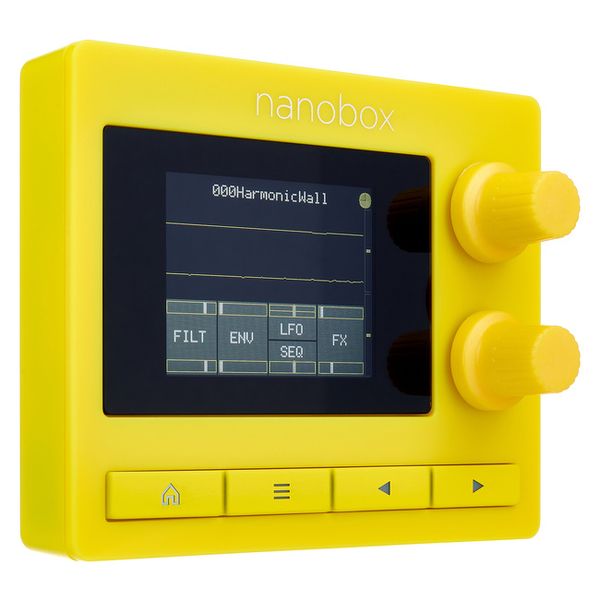
Operating the Nanobox Lemondrop could scarcely be simpler, thanks to the four buttons, two endless encoders, and the clear and compact 2" touchscreen. Tapping on the waveform display provides access to the detailed parameters of the Lemondrop’s three oscillators: Two are dedicated to granular synthesis and allow two distinct samples to be merged simultaneously, while the third oscillator blends in a third waveform proportionally. Parameters can also be modulated in real time using X/Y positioning on the touchscreen. Alongside pitch, beat sync, density and level, there are also controls for grain size, window, jitter, and pan random – all of which combine to shape some genuinely complex sounds, further enhanced by the onboard effects.
Intuitive synthesis
The Nanobox Lemondrop's a great choice for audio artists after a compact granular synth they can always have on hand for spontaneous jam sessions. It measures less than 10cm square, but packs a serious punch when it comes to sound – and it's so easy to load in new .wav files to keep things fresh. Compared to the Nanobox Fireball, there's even more parameters to play around with, so that finely tuned individual sound can be taken absolutely anywhere. Fortunately, the stripped-back interface makes for a really intuitive workflow: However, with the mini-TRS to MIDI adapter cable included as standard, the Lemondrop can also be hooked up to external gear, meaning it there's almost no end to the options available for sound shaping. Power is supplied via the USB-C cable it also ships with, keeping things nice and simple.
)
About 1010music
1010music was founded in Los Angeles in 2016 and focuses on digital solutions for musical applications. Prior to creating their own products, the developers at 1010music had all worked for renowned companies on large software projects such as Native Instrument's Traktor DJ. 1010Music’s creative modules – designed for Eurorack modular systems such as samplers, loopers, sequencers, synthesizers and effects – combine digital technology with analogue controls and are operated via multifunctional touch displays.
)
Seamless integration
Lined up neatly on the top edge of the Nanobox Lemondrop are all the ports needed to integrate it seamlessly into any setup. It accepts MIDI commands via the MIDI input, and that signal can be passed on to other gear via the MIDI output. The Lemondrop supports note on/off, mod wheel, sustain, pitch bend, mono and poly aftertouch, CC messages, as well as MIDI clock synchronisation via a dedicated clock input. A dedicated audio input also allows external sources to be integrated and processed via the internal engine and effects. This compact granular synth's internal tempo can be set by simply pressing the right-most button while in the main menu, which is also where users can adjust the pitch bend range and reset the oscillator. Because of its tiny size, the synth outputs stereo signals through two 3.5mm jacks. If it's going into a pro setup, a breakout cable (sold separately) will be a necessary accessory.
