


Arturia MicroBrute UFO

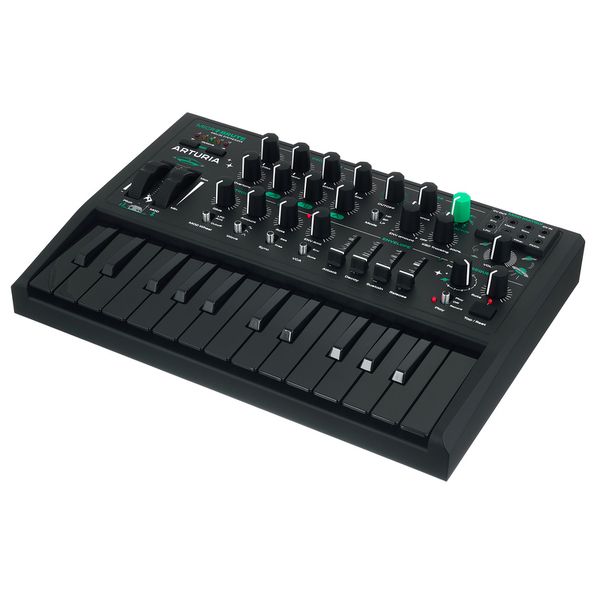
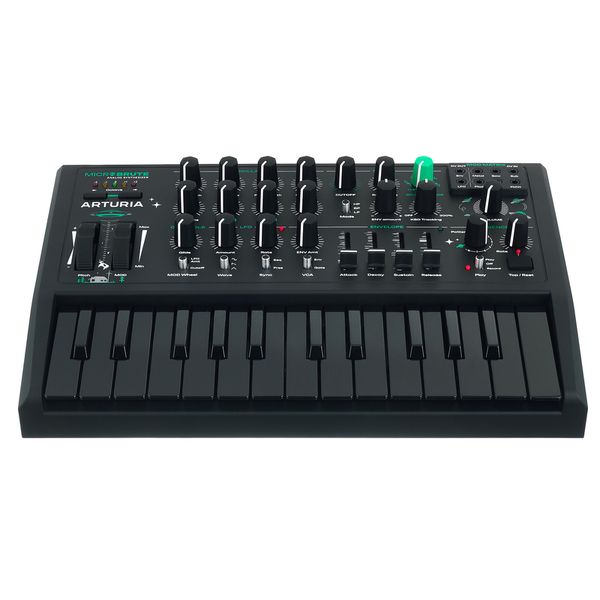
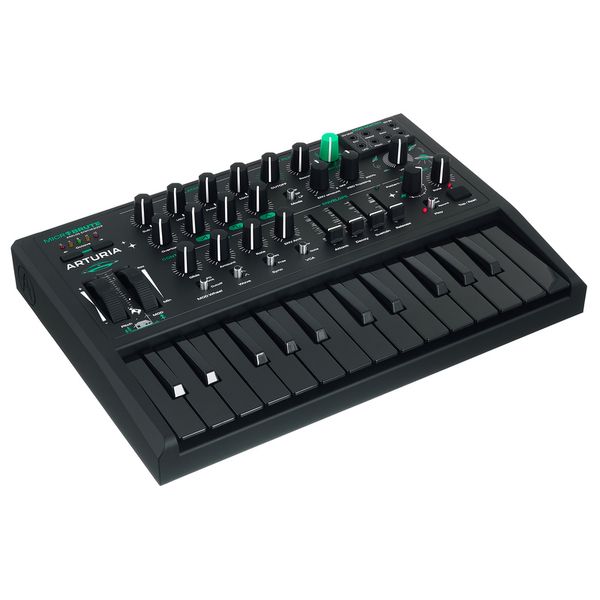
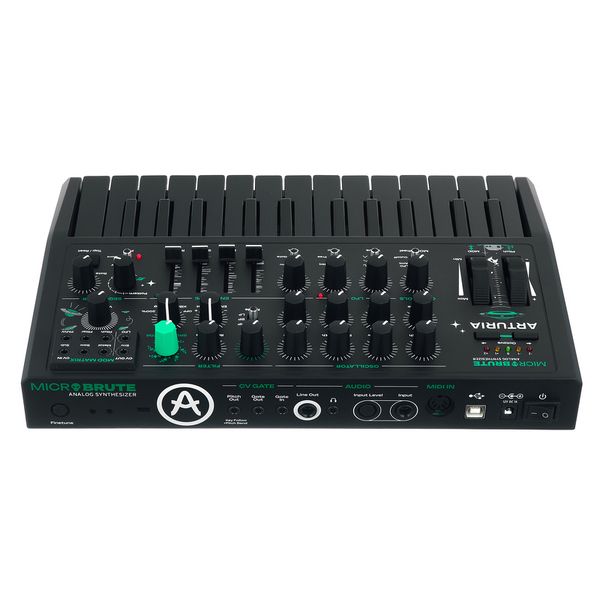
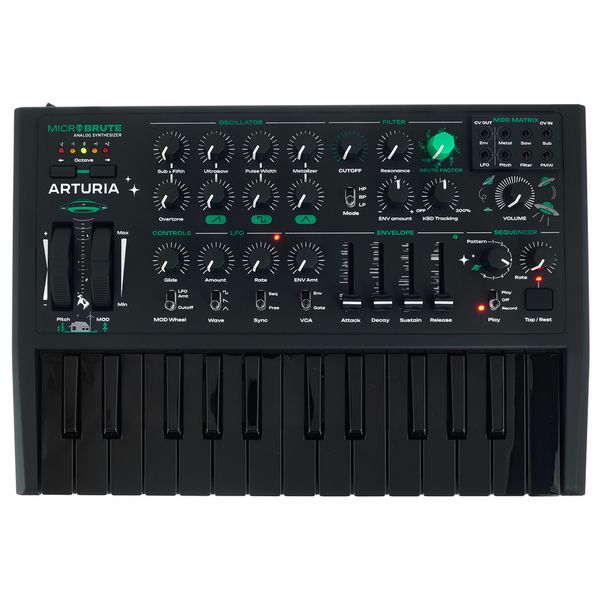
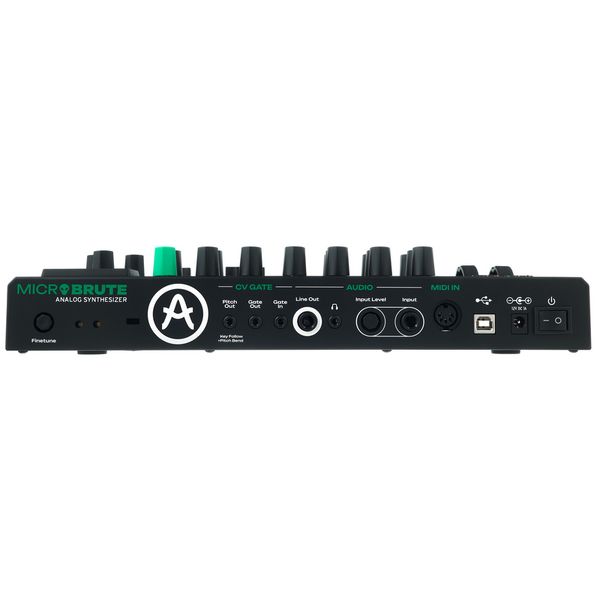
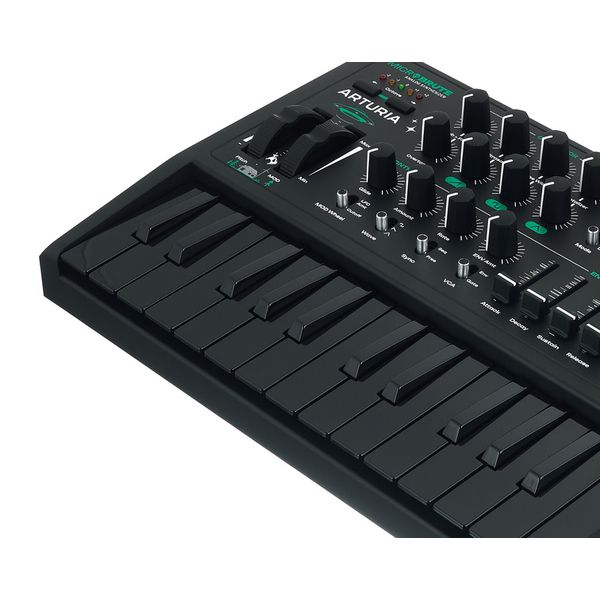
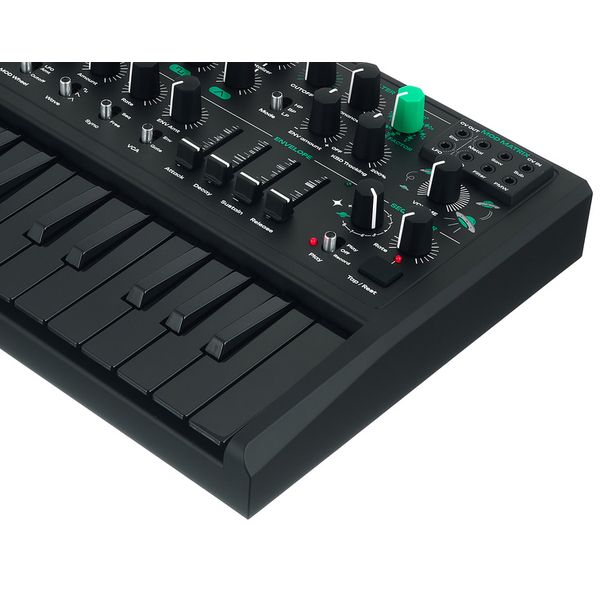
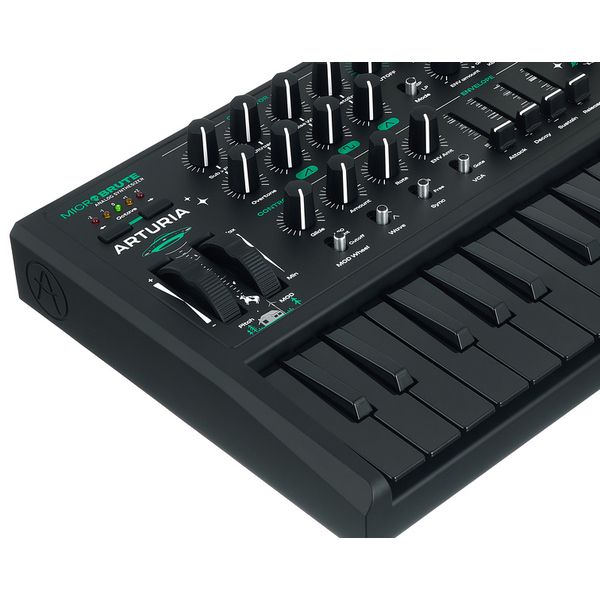
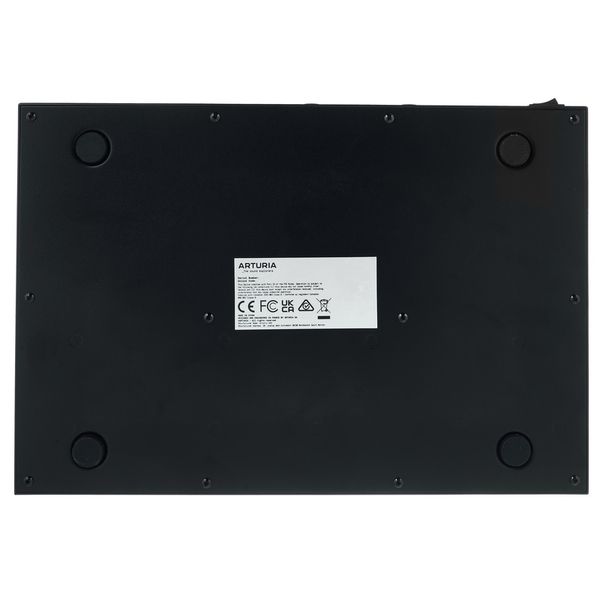
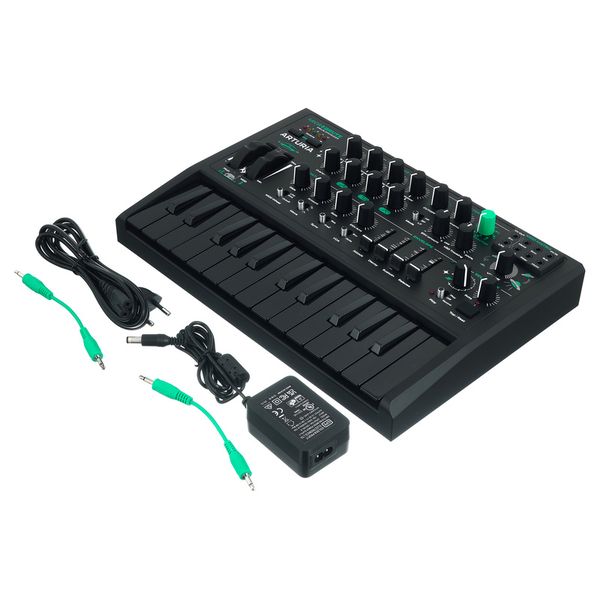


Monophonic Analogue Synthesizer
- Limited special edition
- 25 mini keys
- Analogue signal path
- Step sequencer (eight sequences with up to 64 steps)
- Filter section with brute factor pot
- Patchable modulation matrix
- Steiner-Parker multi-mode filter (LP, BP, HP)
- Voltage-controlled oscillator with overtone sub-oscillator
- Oscillator mixer: Sub, Sawtooth, Square, Triangle
- Pulse width
- Ultra Saw
- Metalizer
- Synchronisable LFO with three waveforms
- ADSR and gate envelope
- Retractable knob for fine tuning
- Pitch and modulation wheel
- Octave button (-2 to +2)
- Dimensions (L x W x H): 325 x 221 x 60 mm
- Weight: 2 kg
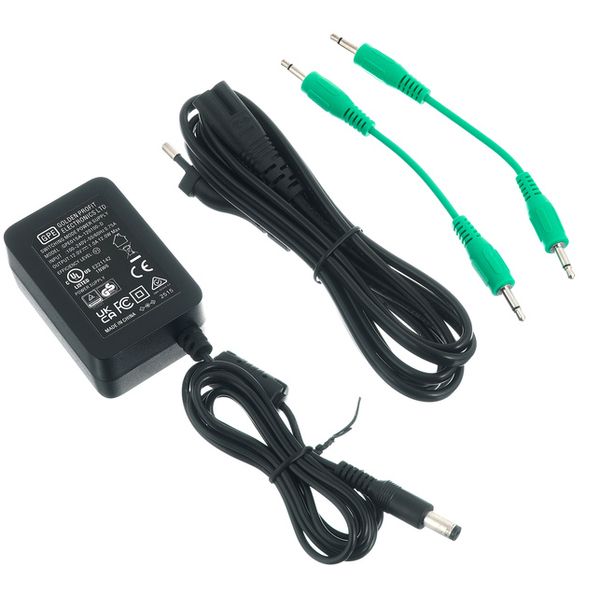
- Including power supply (12 V DC, 1 A), two patch cables (3.5 mm mini jack) and registration card
Connectors:
- Line input: 6.3 mm jack
- Line output: 6.3 mm jack
- Headphone output: 3.5 mm mini jack
- Pitch output: 3.5 mm mini jack
- Gate input and output: 3.5 mm jack
- MIDI input: 5-pin DIN
- USB-B connection
-
Available since September 2025
-
Item number 620845
-
Sales Unit 1 piece(s)
-
Number Of Keys 25
-
Touch-Sensitive Yes
-
Aftertouch No
-
Split Zones No
-
Modulation Wheel Yes
-
Number of simultaneous Voices 1
-
Sound Engine Analogue
-
MIDI interface 1x In
-
Storage Medium None
-
USB-port Yes
-
Effects None
-
Arpeggiator No
-
Number of Analog Outputs 1
-
Digital Output No
-
Display No
-
Pedal Connections None
-
Dimensions 325 x 221 x 60 mm
-
Weight 2,0 kg
-

Brute form factor, UFO style
)
Arturia's MicroBrute UFO Edition revisits the compact analogue monosynth that helped define the Brute series, here presented in a striking limited-edition finish with space-black panels, all-black keys, and Martian-green graphics. Built around a fully analogue signal path with a single but capable oscillator, a Steiner-Parker multimode filter, and the Brute Factor feedback circuit, the MicroBrute UFO delivers solid basses, edgy leads, and unpredictable harmonic textures alike. A patchable Mod Matrix, onboard step sequencer, and a hands-on interface facilitate sound-design and pattern creation, all without screens or menu navigation. The MicroBrute keeps synthesis immediate and tactile, while its compact footprint fits seamlessly into desktop studios, portable live rigs, or larger hardware setups.

)
Single VCO, expanded range
The MicroBrute's voltage-controlled oscillator defies single-VCO expectations. Saw, square, and triangle waveforms can be blended and processed via Arturia’s Ultrasaw thickening, Metalizer waveshaping, and PWM modulation, while an Overtone sub/5th generator both reinforces fundamentals and adds harmonic layers – a feature typically found in multi-oscillator designs. The signal then passes through the classic Steiner-Parker multimode filter, offering low-pass, band-pass, and high-pass responses with self-oscillating resonance for aggressive tones. At the end of the signal path, the Brute Factor feedback circuit pushes the filter from subtle saturation to heavier distortion, adding weight, harmonic density, and the unmistakable Brute-series character.
)
Sequencing and modulation
The Arturia MicroBrute's onboard step sequencer – fully synchronisable to internal, modular, MIDI, or DAW clock sources – encourages pattern-based experimentation. Up to eight sequences (each with 64 steps) can be stored internally, allowing bass lines, riffs, or evolving patterns to be performed via the keyboard, pitch and modulation wheels, and then reshaped in real time. Tap tempo and rate controls allow on the fly timing adjustments, while the sequencer can be synchronised to internal or external clock signals. Modulation is immediate and hands-on: A classic ADSR envelope and an LFO (with three selectable waveforms) can be routed via the Mod Matrix to destinations like oscillator pitch, filter cutoff, or waveform modifiers. The LFO can run freely or sync to the clock, keeping modulations locked in at all times.
)
About Arturia
Arturia's success story began with software emulations of well-known analogue synthesizers such as the Moog Minimoog, Sequential Prophet-5, and Oberheim SEM. The popular software instruments included in the V Collection are still flagship products of the French developer today. Over time, Arturia has gradually expanded its range and now also offers a host of hardware devices, ranging from synthesizers and keyboard controllers to sequencers. Since then, the former software developer has thus also become a household name in the world of analogue synthesizers and other equipment.
Mod Matrix and connectivity
The MicroBrute’s patchable Mod Matrix greatly expands its modulation capabilities, allowing external CV control of parameters such as pitch, filter cutoff, pulse width, Metalizer, and other oscillator modifiers, while CV outputs provide pitch, envelope, and LFO signals for driving external devices. This modular-friendly architecture lets the MicroBrute switch from classic monosynth to modulation source and sequencer, greatly expanding its functionality. Connectivity is equally robust: MIDI In (5-pin DIN and USB) provide seamless integration with DAWs and hardware, while the external audio routes signals through the Steiner-Parker filter and Brute Factor circuit. 1/4” main and 1/8” headphone outputs complete the routing, for making it easy to connect mixers, interfaces, or personal monitoring.
In the spotlight
MIDI Control Center software
Arturia's MIDI Control Center software (which works with the manufacturer's many MIDI devices, including the MicroBrute) unlocks deeper configuration and system settings. Users can back up, exchange, and restore sequences via USB – ideal for archiving pattern libraries, preparing live sets, or organising project libraries. The editor also grants access to hidden parameters such as step divisions, trigger modes, MIDI configuration, and pitch-bend range, refining the instrument's tactile, hardware-centric design. By handling these functions in software, the MicroBrute UFO maintains its streamlined front panel while expanding creative potential for studio and live use.
)