


BB
Harley Benton PJ-75 & MV-5PJ shooutout/review:
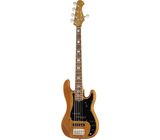
So... this morning I was able to extensively compare the Harley Benton PJ-75 (€199 and with a free Thomann gig bag worth €22) and the Harley Benton MV-5PJ (€249 without a gig bag, so €71 more expensive in total).
And the verdict is pretty clear.
I actually really wanted to like the PJ-75 more because it is cheaper, lighter (poplar vs. alder body), and has a P-width nut (45mm) as opposed to the jazz-width nut on the MV5 (43mm), but the MV5-PJ just sounds much better.
The Roswell pickups in the cheaper HB PJs simply sound very muddy in the low end and thin in the high end, whereas the HBZ pickups in the MV5 can easily keep up with expensive aftermarket pickups.
In my opinion, the alder body of the MV5 also adds a bit more definition compared to the poplar body of the PJ-75.
All in all, the MV5 sounds like a bass that is a few hundred euros more expensive than the PJ75, which more than justifies the €70 price difference; so the more expensive bass wins in this case.
I also had the cheapest and most expensive of the range in my possession for a while (the matte black PJ5 @€149 and the active enhanced MP5 @€349), and regarding those two, the PJ5 came close to the PJ-75 in terms of sound, with the difference mainly in the looks and finish (although that difference was minimal).
The most expensive one in the range looked a bit like the Sandberg MV basses, but given that it arrived with a broken pre-amp and therefore couldn't produce a decent sound, I didn't include it in my review.
Overall, the finish was reasonably good, although with all basses in this series you probably want to have the frets crowned to remove the sharp edges; otherwise, the fretwork was quite good, and I didn't see much difference in that regard between the cheapest and most expensive basses.
In my opinion, the MV-5 is the best buy of the four due to the significant difference in the quality of the pickups, truss rod wheel, luminlay side dots, and alder body, and that is the bass I decided to keep as a backup bass. However, with a pickup swap, the cheaper basses are certainly o.k. for the money too.
And the verdict is pretty clear.
I actually really wanted to like the PJ-75 more because it is cheaper, lighter (poplar vs. alder body), and has a P-width nut (45mm) as opposed to the jazz-width nut on the MV5 (43mm), but the MV5-PJ just sounds much better.
The Roswell pickups in the cheaper HB PJs simply sound very muddy in the low end and thin in the high end, whereas the HBZ pickups in the MV5 can easily keep up with expensive aftermarket pickups.
In my opinion, the alder body of the MV5 also adds a bit more definition compared to the poplar body of the PJ-75.
All in all, the MV5 sounds like a bass that is a few hundred euros more expensive than the PJ75, which more than justifies the €70 price difference; so the more expensive bass wins in this case.
I also had the cheapest and most expensive of the range in my possession for a while (the matte black PJ5 @€149 and the active enhanced MP5 @€349), and regarding those two, the PJ5 came close to the PJ-75 in terms of sound, with the difference mainly in the looks and finish (although that difference was minimal).
The most expensive one in the range looked a bit like the Sandberg MV basses, but given that it arrived with a broken pre-amp and therefore couldn't produce a decent sound, I didn't include it in my review.
Overall, the finish was reasonably good, although with all basses in this series you probably want to have the frets crowned to remove the sharp edges; otherwise, the fretwork was quite good, and I didn't see much difference in that regard between the cheapest and most expensive basses.
In my opinion, the MV-5 is the best buy of the four due to the significant difference in the quality of the pickups, truss rod wheel, luminlay side dots, and alder body, and that is the bass I decided to keep as a backup bass. However, with a pickup swap, the cheaper basses are certainly o.k. for the money too.
5
0
Report
K
Great PJ Bass
Overall really impressed with the build quality and the sound. The materials and build quality feel like they belong on a way more expensive bass. Low B sounds good as well.
Just some slight room for improvement:
However, the frets can be filed better as you can feel that it's sticking out just a bit when you run your hands down the neck.
String spacing measures 18mm between the center of each string on mine, not 20mm as stated.
Just some slight room for improvement:
However, the frets can be filed better as you can feel that it's sticking out just a bit when you run your hands down the neck.
String spacing measures 18mm between the center of each string on mine, not 20mm as stated.
2
0
Report