




DM
Diese Box ist der Hammer!
Kurze Vorgeschichte: für mein kleines Projektstudio waren nach längerem Kampf mit faulen Kompromissen nun endlich vernünftige Monitorlautsprecher fällig. Neumann hatte ich als Hersteller schon länger auf dem Schirm, wenn da nicht die recht sportlichen Preise wären. Am Ende habe ich mich entschieden, nicht einen bestehenden Kompromiss durch einen neuen zu ersetzen, sondern etwas tiefer in die Tasche greifen und bei der KH 80 zuzuschlagen.
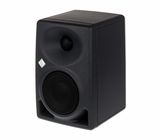
Und das habe ich nicht bereut: die KH 80 ist eine feine kleine Box, sehr wertig verarbeitet und optisch sehr edel. Dem trägt auch das Detail Rechnung, dass Netz- und XLR-Anschluss nach unten und nicht nach hinten gerichtet sind.
Zum Sound muss ich voranstellen, dass mein Arbeitsplatz akustisch recht problematisch ist: rechtwinklig in einer Dachschräge, die linke Box sehr nahe an dieser Schräge und keine Möglichkeit, die Lautsprecher auf Stative zu setzen. Also stehen sie links und rechts neben dem PC-Monitor auf dem Schreibtisch, und zwar auf Fluid Audio DS 5 (siehe meine Besprechung dort).
Angeschlossen, eingeschaltet - und dann hat mich bereits der Grundsound der KH 80 umgehauen. Nur grob über die Schalter auf der Rückseite angepasst, haben die Lautsprecher sogleich die analytische Präzision gezeigt, die ich lange vermisst habe. Unterschiedliche Frequenzen kamen in der Wiedergabe so ausgewogen, dass ich dachte, das könnte eigentlich nicht mehr besser werden.
Denkste. Denn dann habe die KH 80 über die iPad-App kalibriert. Was soll ich sagen - es ist einfach unglaublich, was jetzt die Monitore, selbst im Bassbereich, leisten. Ja, sicher, eine größere Box mit einem größeren Bass-Chassis käme tiefer runter. Weil meine Projekte aber mit und für eine kleine Bluesband entstehen, liefern die KH 80 auch mehr als ausreichende Bässe ab. Die nächstgrößere Box KH 120 kann an der Stelle wahrscheinlich mehr, war mir für den rein privaten Zweck dann aber doch zu teuer. Die Kalibrierung lief übrigens durch eine sehr einfache Benutzerführung reibungslos ab.
Gibt es denn gar nichts zu meckern? Doch, aber bei dem positiven Gesamteindruck nur sehr widerwillig. Ich finde halt, auch die KH 80 hätte einen Netzanschluss mit einer vernünftigen, großen Kaltgerätebuchse verdient. Stattdessen gibt es ein Netzkabel wie von einem Rasierapparat mit dem schmalen Zweipolstecker. Das Kabel sitzt fest im Anschluss, alles gut, aber ich finde die großen, dreipoligen Kaltgeräteanschlüsse einfach vertrauenswürdiger.
Fazit also: für ein kleines Studio ist diese feine Box aufgrund ihres analytischen, dennoch sehr angenehmen Sounds eine klare Empfehlung, wenn man nicht ausufernde Ansprüche im Tiefbassbereich stellt. Die Kalibrierbarkeit macht sie zudem für schwierige Abhörräume zu einer guten Wahl.
Ach ja, fast vergessen: die gewohnt gute Beratung bei Big-T und ein Versand knapp unter Lichtgeschwindigkeit (1 Tag nach Bestellung war die Box am Ziel). Danke, Leute!
Und das habe ich nicht bereut: die KH 80 ist eine feine kleine Box, sehr wertig verarbeitet und optisch sehr edel. Dem trägt auch das Detail Rechnung, dass Netz- und XLR-Anschluss nach unten und nicht nach hinten gerichtet sind.
Zum Sound muss ich voranstellen, dass mein Arbeitsplatz akustisch recht problematisch ist: rechtwinklig in einer Dachschräge, die linke Box sehr nahe an dieser Schräge und keine Möglichkeit, die Lautsprecher auf Stative zu setzen. Also stehen sie links und rechts neben dem PC-Monitor auf dem Schreibtisch, und zwar auf Fluid Audio DS 5 (siehe meine Besprechung dort).
Angeschlossen, eingeschaltet - und dann hat mich bereits der Grundsound der KH 80 umgehauen. Nur grob über die Schalter auf der Rückseite angepasst, haben die Lautsprecher sogleich die analytische Präzision gezeigt, die ich lange vermisst habe. Unterschiedliche Frequenzen kamen in der Wiedergabe so ausgewogen, dass ich dachte, das könnte eigentlich nicht mehr besser werden.
Denkste. Denn dann habe die KH 80 über die iPad-App kalibriert. Was soll ich sagen - es ist einfach unglaublich, was jetzt die Monitore, selbst im Bassbereich, leisten. Ja, sicher, eine größere Box mit einem größeren Bass-Chassis käme tiefer runter. Weil meine Projekte aber mit und für eine kleine Bluesband entstehen, liefern die KH 80 auch mehr als ausreichende Bässe ab. Die nächstgrößere Box KH 120 kann an der Stelle wahrscheinlich mehr, war mir für den rein privaten Zweck dann aber doch zu teuer. Die Kalibrierung lief übrigens durch eine sehr einfache Benutzerführung reibungslos ab.
Gibt es denn gar nichts zu meckern? Doch, aber bei dem positiven Gesamteindruck nur sehr widerwillig. Ich finde halt, auch die KH 80 hätte einen Netzanschluss mit einer vernünftigen, großen Kaltgerätebuchse verdient. Stattdessen gibt es ein Netzkabel wie von einem Rasierapparat mit dem schmalen Zweipolstecker. Das Kabel sitzt fest im Anschluss, alles gut, aber ich finde die großen, dreipoligen Kaltgeräteanschlüsse einfach vertrauenswürdiger.
Fazit also: für ein kleines Studio ist diese feine Box aufgrund ihres analytischen, dennoch sehr angenehmen Sounds eine klare Empfehlung, wenn man nicht ausufernde Ansprüche im Tiefbassbereich stellt. Die Kalibrierbarkeit macht sie zudem für schwierige Abhörräume zu einer guten Wahl.
Ach ja, fast vergessen: die gewohnt gute Beratung bei Big-T und ein Versand knapp unter Lichtgeschwindigkeit (1 Tag nach Bestellung war die Box am Ziel). Danke, Leute!
28
0
Report
m
Brilliant monitors!!!
After much research looking for some small sized studio monitors for my bedroom I decided to go with these KH80s. I was tossing up between these and the iLoud MTM monitors, as much as I've heard the bass response from the MTMs are amazing I'm glad I went with these as they are very, very impressive! Not only are the mids and highs extremely detailed the bass is definitely there, but more controlled and punchy for such a small speaker. I have to say one of the things that blows me away is the centre imaging, it's almost scary how well these monitors present the sound. Extremely impressed.
Anyway there's already plenty of reviews out there for these so if you're on the fence about getting them, just buy them...I love them and I can already tell after the short amount of time my mixing is better for investing in them.
Five stars.
Anyway there's already plenty of reviews out there for these so if you're on the fence about getting them, just buy them...I love them and I can already tell after the short amount of time my mixing is better for investing in them.
Five stars.
11
0
Report

M
Une tuerie
Une paire de moniteurs qui impressionne par son grave (même en ne tenant pas compte du fait que ça n'est que du 4 pouces) et par le rendu particulièrement maitrisé, solide, rien ne bouge quoi. Pas enthousiasmant, c'est pas le propos, on doit les faire sonner, c'est un outil, pas une source de récréation (encore que ça marche particulièrement bien). Les possibilités de réglage/eq via Switch+Ipad sont géniales, il est tout à fait possible de se faire prêter un iPad le temps des réglages et zou ! Je travaille mieux avec ça qu'avec des Focal Shape (qui gardent l'avantage sur l'image stereo je trouve). J'économise pour les accompagner d'un Sub digne de ce nom de la même marque (qui remplacera mon vaillant Presonus Temblor 10). Je préfère mille fois dépenser cette somme pour de petits moniteurs plutôt haut de gamme comme ceux -ci que de mettre autant dans des Adam/Eve/Yam qui ne sont pas à la hauteur tout en étant plus gros (attention, niveau grave pas de miracle non plus, c'est pas le sujet).
9
0
Report

A
Be patient when calibrating
I recently bought a pair of KH80 monitors to pair with my KH750 subwoofer. I initially owned the KH120 II + KH750 sub combination, but the need to work in two different locations arose. To address this, I set up the KH80s with the sub at location 1 and moved the KH120 IIs to location 2, ensuring I had a broad frequency range monitor in both places.
The first time I calibrated the KH120 II with the KH750 sub using the MA-1, it took around three attempts to achieve the perfect sound. Once calibrated, the sound was absolutely perfect—stunning and focused. The soundstage was beyond words, providing an unparalleled listening experience.
However, when I attempted to pair my KH80s with the KH750 sub, I couldn’t achieve the same perfect sound. The KH80s sounded harsh and overly bright, lacking focus. Despite trying three or four times, they still sounded like small, bright, and unfocused monitors. I attributed this to their older design, analog inputs, or their small size. Consequently, I decided to return the KH80s and invest in another pair of KH120 IIs, despite the higher cost.
My cat knocked over the monitor stand, causing one of the KH80s to fall from about 1.2 meters onto a hard floor. This fall resulted in a noticeable scratch, making it impossible to return them. Amazingly, despite the fall, the monitor only suffered a scratch with no apparent functional damage, a testament to its robust construction.
Faced with keeping what I initially thought were suboptimal monitors, I decided to make the best of it and recalibrate. Despite four more attempts, the sound remained boxy, too bright, and unfocused. It lacked the immersive quality of the KH120 IIs.
Then, on my last attempt, a miracle happened. I played the first song, and the sound was astounding. It was finally the same amazing sound as the KH120 IIs—pure and focused, with a soundstage that made the music come alive.
Here are my learnings for achieving the best calibration:
Precision is key. The more precise your measurements, the better the calibration. Measure with care and follow the program’s indicated centimeters exactly.
Point the monitors slightly behind your head, not directly at your face. This is crucial for achieving the perfect sound.
Place your subwoofer close to the wall. My sub is to the right, just before the right monitor.
Ensure no surfaces obstruct the space between the microphone and the monitor or subwoofer. Remove the studio table if necessary.
Maintain absolute silence during measurements. Even minor vibrations during the measurement process can affect the final result.
Be patient. If the sound and depth aren’t amazing, the calibration isn’t perfect. Repeat the process until it is.
The first time I calibrated the KH120 II with the KH750 sub using the MA-1, it took around three attempts to achieve the perfect sound. Once calibrated, the sound was absolutely perfect—stunning and focused. The soundstage was beyond words, providing an unparalleled listening experience.
However, when I attempted to pair my KH80s with the KH750 sub, I couldn’t achieve the same perfect sound. The KH80s sounded harsh and overly bright, lacking focus. Despite trying three or four times, they still sounded like small, bright, and unfocused monitors. I attributed this to their older design, analog inputs, or their small size. Consequently, I decided to return the KH80s and invest in another pair of KH120 IIs, despite the higher cost.
My cat knocked over the monitor stand, causing one of the KH80s to fall from about 1.2 meters onto a hard floor. This fall resulted in a noticeable scratch, making it impossible to return them. Amazingly, despite the fall, the monitor only suffered a scratch with no apparent functional damage, a testament to its robust construction.
Faced with keeping what I initially thought were suboptimal monitors, I decided to make the best of it and recalibrate. Despite four more attempts, the sound remained boxy, too bright, and unfocused. It lacked the immersive quality of the KH120 IIs.
Then, on my last attempt, a miracle happened. I played the first song, and the sound was astounding. It was finally the same amazing sound as the KH120 IIs—pure and focused, with a soundstage that made the music come alive.
Here are my learnings for achieving the best calibration:
Precision is key. The more precise your measurements, the better the calibration. Measure with care and follow the program’s indicated centimeters exactly.
Point the monitors slightly behind your head, not directly at your face. This is crucial for achieving the perfect sound.
Place your subwoofer close to the wall. My sub is to the right, just before the right monitor.
Ensure no surfaces obstruct the space between the microphone and the monitor or subwoofer. Remove the studio table if necessary.
Maintain absolute silence during measurements. Even minor vibrations during the measurement process can affect the final result.
Be patient. If the sound and depth aren’t amazing, the calibration isn’t perfect. Repeat the process until it is.
5
0
Report
W
Accurate monitors
I bought these about 9 months ago, so I've had time to learn them somewhat and get past the honeymoon phase. I'm a hobbyist now, but I ran a small-but-busy recording studio in the past, mostly working with local bands.
TLDR, I have nothing bad to say about these, I think they're fantastic.
I'm using them in a very small, but reasonably well-treated room in combination with the MA1 calibration system. Even without the calibration they're great, but it's a big help in my room, which has some pretty big issues with standing waves in the low and lower-mid range. I'd describe the character of the monitors as 'grey and unexciting, but not boring'.
Long story short, they're terrific. I'm very happy with my mixes and they translate well. I find the monitors accurate and unhyped, and they show me what isn't working. If something sounds 'off' through these monitors, then it's off. If it sounds good, then it probably is. For me, there's a lot less guess-work than I've had in the past. I simply mix so it sounds good on the monitor, no intellectual exercises required. Stereo imaging is great, centre imaging is great, depth-of-field is great.
I also have a single Mixcube to check mono compatibility, mid-range and transient response, but I usually don't have to make too many adjustments after working on the Neumanns. With this setup, I rarely get any surprises after I check on real-world systems (phone, laptop, earbuds, TV, clock radio, etc).
I also check the low end on Beyerdynamic DT880pros and Audio Technica ATHm50s', but I don't find too many surprises there, probably because I tend to high-pass quite a lot.
Less related to the monitors, but one unexpected benefit of my small room is that, if I stand 2m back from my mix position, the Neumann's (surprisingly) are still putting out frequencies as low as 40Hz, which gives me a ballpark idea of whether or not my hi-pass EQs are set right, especially when compared to reference mixes. It's a quirk of my room so won't apply to everyone, but it helps reveal woofiness in the low end.
I've had Yamaha HS50m's, Adam A7X's and Genelec 8030's in the past, but I prefer the Neumanns. For my purposes, I think they're all I'll ever need and I trust them 100%.
TLDR, I have nothing bad to say about these, I think they're fantastic.
I'm using them in a very small, but reasonably well-treated room in combination with the MA1 calibration system. Even without the calibration they're great, but it's a big help in my room, which has some pretty big issues with standing waves in the low and lower-mid range. I'd describe the character of the monitors as 'grey and unexciting, but not boring'.
Long story short, they're terrific. I'm very happy with my mixes and they translate well. I find the monitors accurate and unhyped, and they show me what isn't working. If something sounds 'off' through these monitors, then it's off. If it sounds good, then it probably is. For me, there's a lot less guess-work than I've had in the past. I simply mix so it sounds good on the monitor, no intellectual exercises required. Stereo imaging is great, centre imaging is great, depth-of-field is great.
I also have a single Mixcube to check mono compatibility, mid-range and transient response, but I usually don't have to make too many adjustments after working on the Neumanns. With this setup, I rarely get any surprises after I check on real-world systems (phone, laptop, earbuds, TV, clock radio, etc).
I also check the low end on Beyerdynamic DT880pros and Audio Technica ATHm50s', but I don't find too many surprises there, probably because I tend to high-pass quite a lot.
Less related to the monitors, but one unexpected benefit of my small room is that, if I stand 2m back from my mix position, the Neumann's (surprisingly) are still putting out frequencies as low as 40Hz, which gives me a ballpark idea of whether or not my hi-pass EQs are set right, especially when compared to reference mixes. It's a quirk of my room so won't apply to everyone, but it helps reveal woofiness in the low end.
I've had Yamaha HS50m's, Adam A7X's and Genelec 8030's in the past, but I prefer the Neumanns. For my purposes, I think they're all I'll ever need and I trust them 100%.
2
1
Report

HV
Awesome
I bought a pair of Neumann KH 80 DSPs for my home studio. As a composer of contemporary and electronic music, I work in several recording and electronic music studios across Europe. So, I would say that I have enough experience with loudspeakers and sound. What I can say about the Neumann KH 80 DSPs is that they are clear, defined and balanced. In addition, they are light, small and elegant. In addition to my home studio, I used them in 2 live electronic music concerts, in small rooms with about 50 people. I can only say good things about them. Have in mind that, depending on the style of music, they are not powerful in the low frequencies. Due to their clarity, they are also great for spatialization and I will soon buy another pair of Neumann KH 80 DSPs to carry out my experiments with quadraphony spatialization.
0
0
Report
D
Software bug
I strongly advise against purchasing this product, not because of the sound quality but because of the software. It's full of bugs, sometimes rendering these speakers temporaly unusable and not turning on again. Standby problems. I've spoken to support and they're aware of the issues, but they've been around for years. I don't think they have an adequate development team. You'll end up with a very expensive Ferrari with a dead battery.
0
0
Report

m
Il TOP
Avevo in programma da tempo di acquistare questi piccoli monitors da studio per un upgrade di qualita´, beh le aspettative non sono state deluse! Suono a fuoco, immagine stereo nitidissima e centro molto definito. Con i precedenti monitors usavo anche un sub, ma con queste Neumann non e´piu´necessario. Nonostante le piccole dimensioni hanno bassi e potenza in abbondanza.
Dopo avere collegato tutto come da manuale, ho fatto la taratura dell´ambiente tramite la loro app ed in mezz´ora scarsa avevo gia´completato il setup, che nel mio caso di studio piccolo e dall´acustica discutibile, e´stato un tocca sana. Che dire... consigliatissime!!!!
Dopo avere collegato tutto come da manuale, ho fatto la taratura dell´ambiente tramite la loro app ed in mezz´ora scarsa avevo gia´completato il setup, che nel mio caso di studio piccolo e dall´acustica discutibile, e´stato un tocca sana. Che dire... consigliatissime!!!!
0
0
Report
DS
A step towards meeting sound quality.
These are my first monitors. I was worried that for a room with an area of 22m ^ 2 they can be "rather weak." I decided to take 80 or 120. I chose 80 with the expectation that if there is not enough power for bass, I will get a subwoofer. As a result, I can not bring them to full capacity, because there is enough power. In all senses. About the sound: sitting in front of them, it seems that something is in the way. It turns out this is open eyes, for the whole sound is already in the head. I'm getting used to it.
- The only minus is the DSP functionality, why the minus? Because only apple, iOS 10.3. (I have an old ipad with 9.3) win, android - they generally stayed away. ( .
I still really hope in this regard the manufacturer company will somehow work to adapt to other platforms of its software. I don’t really want to buy an ipad just for admission to the software.
~~~
In three words. Power. Quality. Detalisation.
- The only minus is the DSP functionality, why the minus? Because only apple, iOS 10.3. (I have an old ipad with 9.3) win, android - they generally stayed away. ( .
I still really hope in this regard the manufacturer company will somehow work to adapt to other platforms of its software. I don’t really want to buy an ipad just for admission to the software.
~~~
In three words. Power. Quality. Detalisation.
10
2
Report
r
Sehr gute Lautsprecher mit kleinen Schwächen
Der Klang der Lautsprecher ist sehr gut, so wie schon in vielen anderen Rezensionen hier beschrieben. Durch die Verwendung des Einmess-Systems "Neumann MA 1" konnte ich den Bass in meinem nicht optimierten Raum nochmal sehr deutlich verbessern. Leider schließt die Verwendung der PC Software "MA 1" aber die Benutzung der IPAD Software "Neumann Control" aus. Im Handbuch zu MA 1" heißt es dazu:
- "Uninstall the Neumann Control app from your Pad"
- "Do not use the Neumann Control app on an aligned system"
Das heißt im Klartext, wenn man aus seinen KH 80 alles an Klang herausholen will, muss man aktuell (Februar 2021) auf die Einstellung der LED-Helligkeit oder der Standby-Zeit und -Einschaltschwelle verzichten, jedenfalls so lange, wie diese Merkmale nicht auch in der PC Software zur Verfügung stehen.
Mit der Standby Funktion habe ich allerdings ohnehin Probleme. Die Lautsprecher wachen bei mir nach mehrstündiger Pause nicht mehr aus dem Standby auf. Man muss sie hinten am Schalter ausschalten, etwas warten und wieder einschalten. Das konnte ich an zwei Paaren feststellen, nachdem Thomann das erste Paar anstandslos ersetzt hatte.
Auf eine weitere Rücksendung werde ich verzichten, da ich nicht glaube, dass so etwas ein Individualfehler an vier Exemplaren sein kann. Ich empfehle statt dessen eine Master/Slave Steckdosenleiste mit dem PC als Master und den Boxen als Slave zu benutzen.
- "Uninstall the Neumann Control app from your Pad"
- "Do not use the Neumann Control app on an aligned system"
Das heißt im Klartext, wenn man aus seinen KH 80 alles an Klang herausholen will, muss man aktuell (Februar 2021) auf die Einstellung der LED-Helligkeit oder der Standby-Zeit und -Einschaltschwelle verzichten, jedenfalls so lange, wie diese Merkmale nicht auch in der PC Software zur Verfügung stehen.
Mit der Standby Funktion habe ich allerdings ohnehin Probleme. Die Lautsprecher wachen bei mir nach mehrstündiger Pause nicht mehr aus dem Standby auf. Man muss sie hinten am Schalter ausschalten, etwas warten und wieder einschalten. Das konnte ich an zwei Paaren feststellen, nachdem Thomann das erste Paar anstandslos ersetzt hatte.
Auf eine weitere Rücksendung werde ich verzichten, da ich nicht glaube, dass so etwas ein Individualfehler an vier Exemplaren sein kann. Ich empfehle statt dessen eine Master/Slave Steckdosenleiste mit dem PC als Master und den Boxen als Slave zu benutzen.
10
2
Report