


To the page content

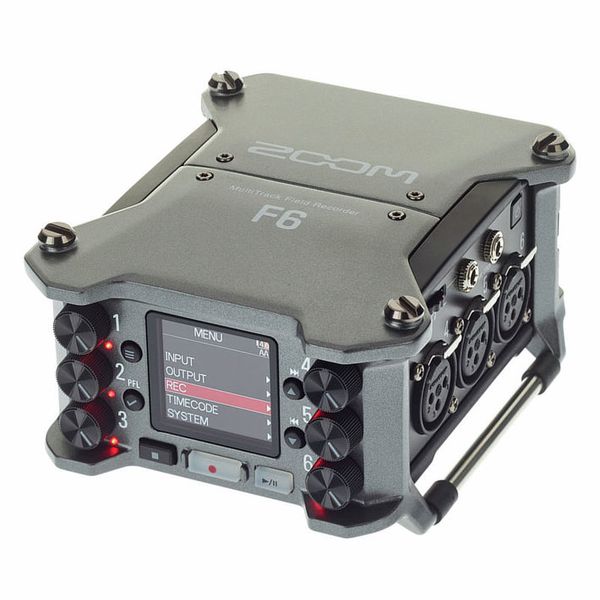
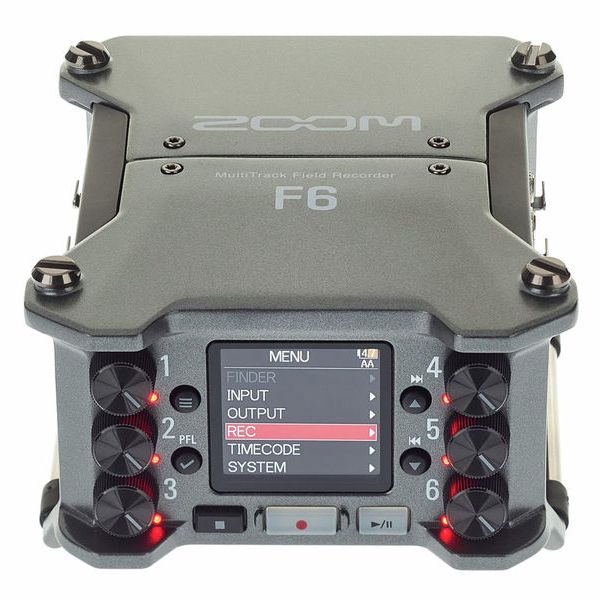
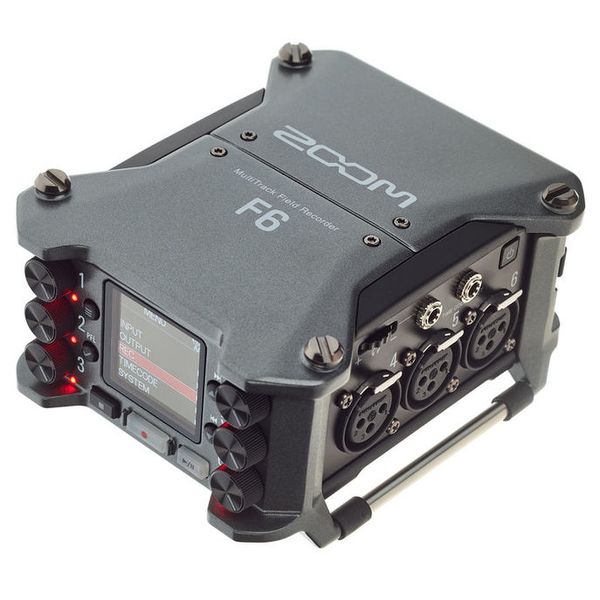
Multitrack Field Recorder

  • 6 Channels
  • 14 Tracks
  • 32 Bit float recording via dual AD converter
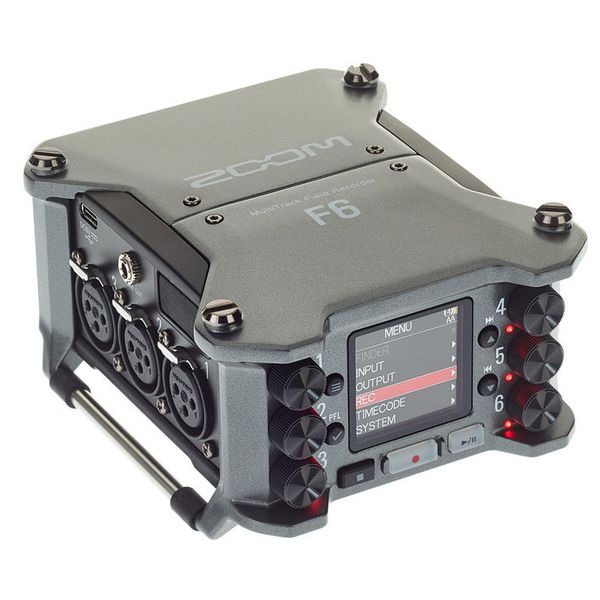
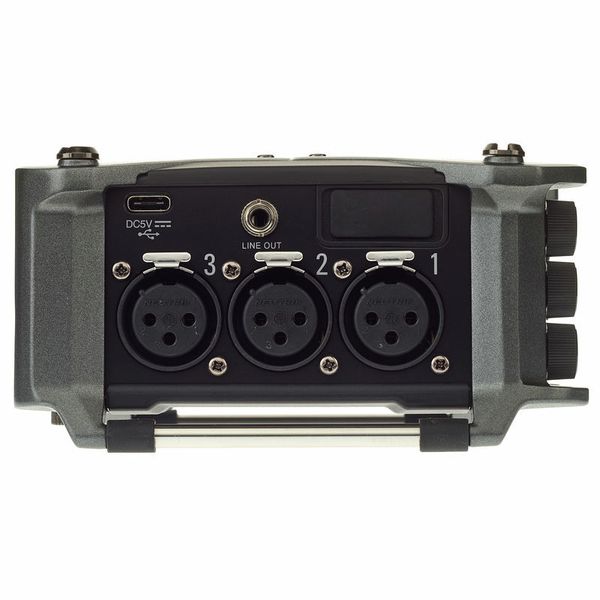
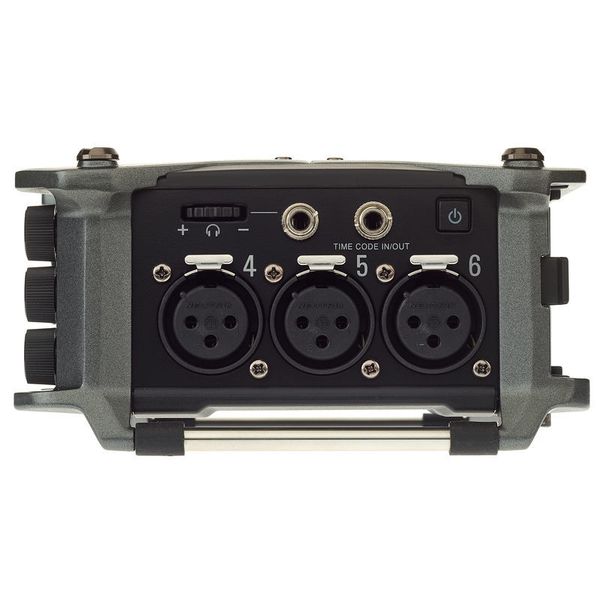
  • 6 Inputs: XLR female
  • Compact and light aluminium housing
  • High-quality microphone preamplifier with up to 75 dB gain
  • Inherent noise: -127 dBu (A-weighting, Gain = 75dB, 150 Ohm source impedance)
  • With phantom power (+48 V / +24 V)
  • Look-ahead hybrid limiter with one millisecond time offset to avoid clipping
  • Simultaneously record onto SD card and computer via USB connection
  • Recordings up to 32 bit / 96 kHz or 24 bit / 192 kHz
  • Works as a 6 in / 4 out USB audio interface with max. 96 kHz
  • Time code input and output via 3.5 mm TRS jack
  • 3.5 mm stereo jack output
  • 3.5 mm stereo headphone output
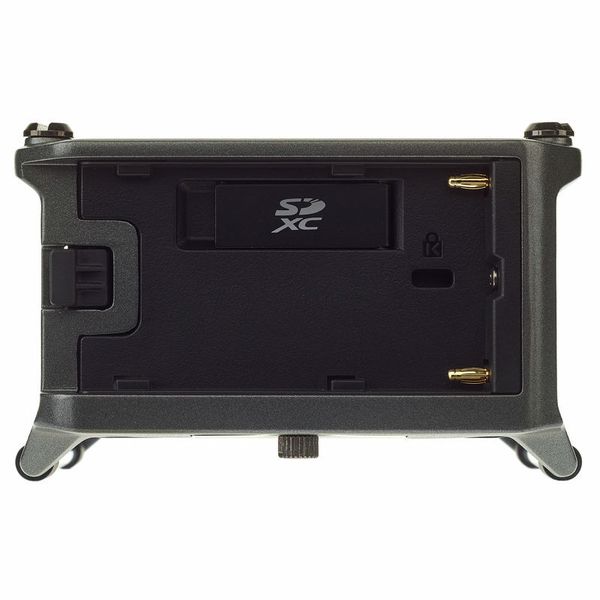
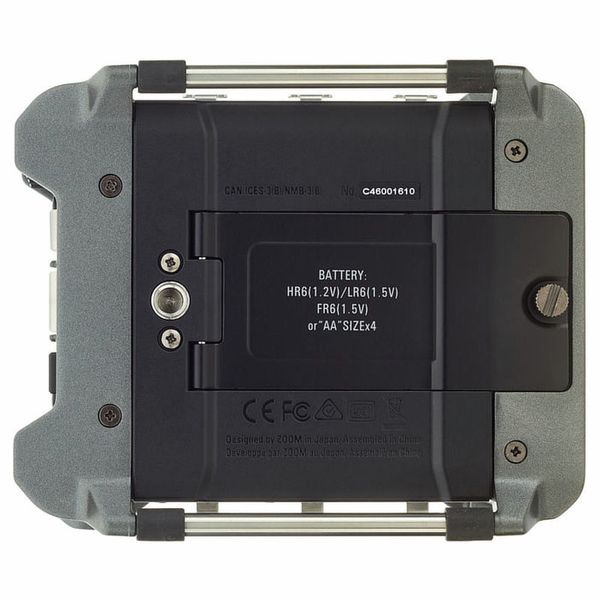
  • 3 Power options: 4 x type AA batteries (not included), Zoom AD-17 power supply (optional) or Sony L-series batteries (optional)
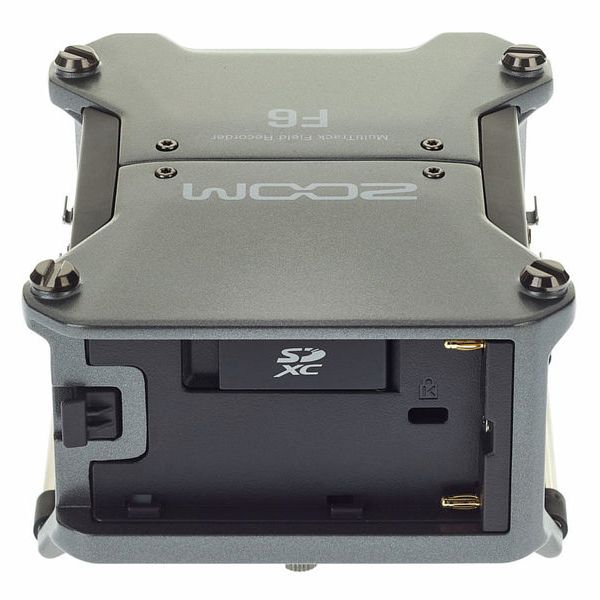
  • Slot for SD/SDHC/SDXC cards with up to 512 GB
  • Remote control via free Zoom F Control iOS app (requires optional Zoom BTA-1 Bluetooth adapter)
  • Controllable via optional zoom F-Control FRC-8
  • Dimensions (W x D x H): 100 x 119.8 x 62.9 mm
  • Weight: 520 g
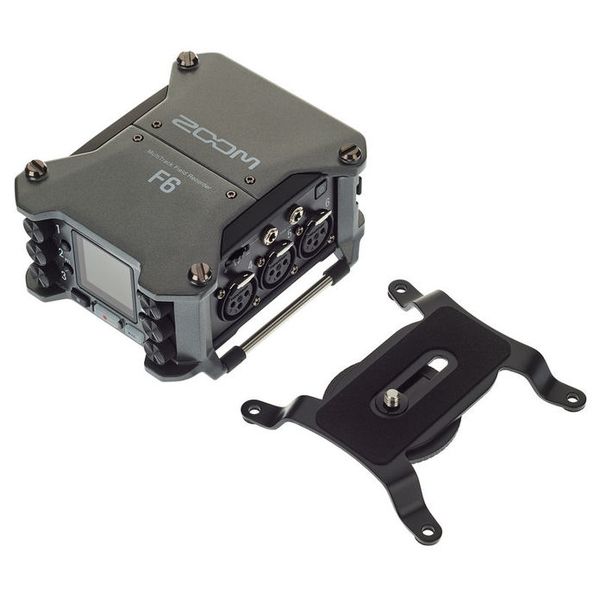
  • Includes camera mount adapter and operating instructions
  • Suitable bag: Article no. 484615 (not included)
  • Suitable case: Article no. 489626 (not included)
  • Available since October 2019
  • Item number 467020
  • Sales Unit 1 piece(s)
  • Integrated Stereo Microhone No
  • Recording Tracks 6
  • Microphone Inputs 6
  • 48 V Phantom power Yes
  • Line Inputs 6
  • Storage Medium SD/SDHC/SDXC
  • Headphone connection Yes
  • Integrated Speaker No
  • Resolution max. 32 bit
  • Max. Sample Rate 192 kHz
  • Limiter Yes
  • Max. Memory 512
  • Recording Format wav, mp3
  • Power Feed Power Supply, Batterie, Accu
  • Dimensions 100 x 120 x 63 mm
  • Weight 520 g
  • Included In Delivery Camera Manual
$539
The shipping costs are calculated on the checkout page.
In stock
1

For dynamic outdoor recordings

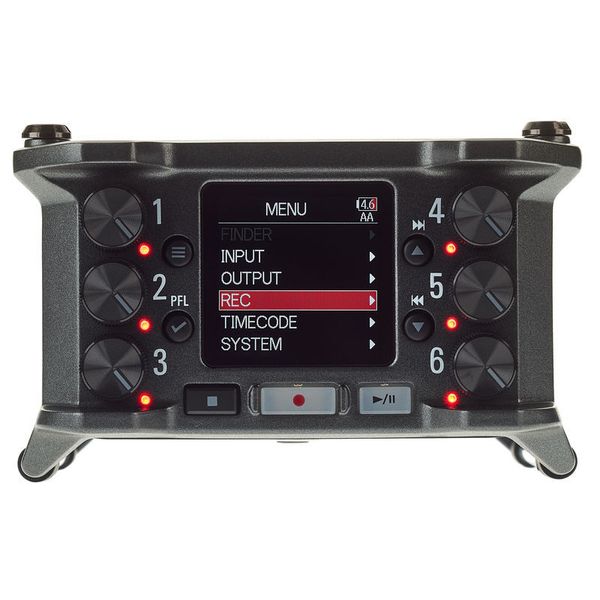
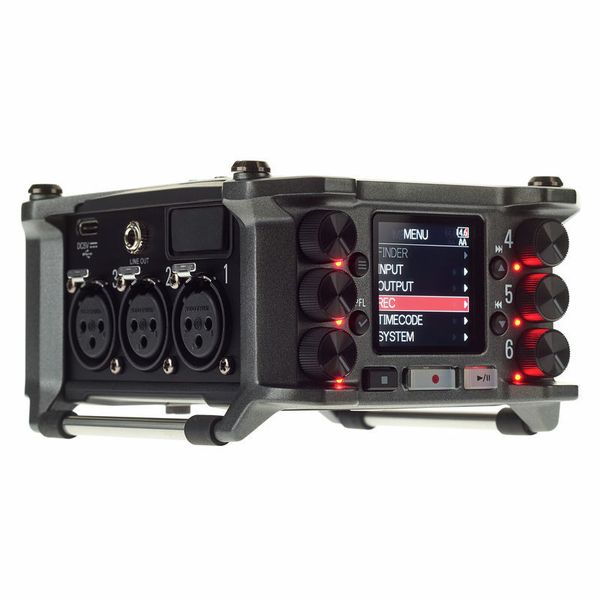
The remarkably compact six-channel Zoom F6 field recorder combines 32-bit float recording, dual A/D converters, and ultra-low-noise preamps (-127dBu EIN) to deliver professional-quality audio across an exceptionally wide dynamic range. It features six independently adjustable XLR inputs, intuitive front-panel controls, a high-resolution 1.54" backlit LCD screen, and highly accurate timecode generation with 0.2ppm precision via 3.5mm input and output connections. Recordings can be stored on SD, SDHC or SDXC cards with capacities of up to 512 GB. The F6 also functions as a six-input, four-output audio interface supporting up to 96kHz/24-bit while recording to an SD card at the same time.
Zoom F6 Digital Field Recorder

No clipping

The dual analogue-to-digital conversion system uses one converter for low-level signals and another for high-level signals, with a dedicated algorithm that continuously monitors the input and automatically selects the appropriate converter. Combined with 32-bit float recording, this approach eliminates the need to set input gain precisely, as the available dynamic range is sufficient to capture both quiet and loud sources without clipping. As a result, rapidly changing sound levels on location become far easier to manage, while reducing the need for corrective work during post-production. For recordings made in 16- or 24-bit resolution, the Advanced Look-Ahead Hybrid Limiter, featuring a one-millisecond delay, provides additional protection against clipping.

Zoom Field Recorder display

With Ambisonic compatibility

The Zoom F6 is designed for professional film and video production, offering six inputs and up to 14 recording tracks to capture complex soundscapes with ease. Its highly stable timecode ensures accurate synchronisation between audio and video, while Ambisonic support enables the creation of immersive spatial audio for VR, AR and other applications. Remote operation is available via the optional F-Control, which connects over USB and provides hands-on mixer-style control. Alternatively, the F6 Control app for iOS can be used when paired with the optional BTA-1 Bluetooth adapter. Flexible power options include alkaline, lithium and NiMH AA batteries, Sony L-series batteries, or USB power, making the recorder well suited to a wide range of recording environments.

Zoom F6 Field Recorder connectors

About Zoom

Founded in 1983, the Japanese company Zoom manufactures a variety of audio equipment, including a range of portable "handy" recorders as well as multi-effects processors, effects pedals, drum machines, and samplers. Over the past thirty years, the company has built a reputation for producing innovative yet affordable products based on original microchip designs. Since the Zoom-9002 (an ultra-compact multi-effects processor that can be attached to a guitar strap) was introduced in 1990, Zoom has become one of the leaders in digital audio processing.

Flexible use

The Zoom F6 records mono, stereo, and multitrack audio in BWF-compliant WAV format at sample rates of up to 192kHz with 32-bit float resolution, while also supporting a range of MP3 formats at up to 320kbps/48kHz for stereo mix (L/R) recording. Its front-panel controls provide quick access to essential functions during recording, even when the recorder is positioned upright inside a bag. For bag-free operation, the supplied CM-F6 adapter plate allows a camera to be mounted directly on the recorder while the F6 itself is attached to a tripod. Two robust brackets integrated into the housing also make it easy to carry the recorder on a belt.

129 Customer ratings

4.8 / 5

handling

features

sound

quality

99 Reviews

C
32 Bit Float is an absolute game changer!
CSingh 18.01.2022
I use this to record live music in multichannel to mix in the box post event.

32 Bit float allows me to focus on mic setup and placement and not have to worry about setting levels or gains on the device as in the DAW it is magical to see peaks which look clipped but when normalised are absolutely perfect.

Simply cannot go back to 24bit recorders now :/ This tech should be in everything that records audio!

One personal negative issue is that 6 inputs is just not quiet enough for my use-case. Really wish Zoom made a 12 XLR input version of this. It would be end-game for sure.

So to get around the 6 input issue, I now use two of these in a master/slave relation so hit record on master and both start recording so no sync issues in post! If you want to do this.....use the Timecode input/output port for the master using a TRS cable and then use a TRS to Mono converter on the slave port. Adjust the settings in the menus for the slave to accept timecode from the port and then watch the timecode sync to the master and hit record and see the red lights on both go on ^^....you're welcome.
handling
features
sound
quality
15
0
Report

Report

D
Great Sound Quality and Size but Awkward User Interface
DrCheese 27.01.2024
I will list the good and bad aspects of the Zoom F6 but will note that overall I think this is a great device. For context, I am coming from a Zoom F4 but I have experience with most of Zoom's devices.

Good:
- Amazing amount crammed into a tiny package. In particular the six XLR inputs.
- 32-bit float
- Very quiet and transparent mic preamps. These seem to be the same as those that are in the F8n Pro and the F3. The ones in the F4 seemed to be slightly different at 192 kHz (although this might be more to do with the anti-aliasing filters).
- Battery life of 4 x AA batteries is surprisingly good. I am coming from the Zoom F4 which uses 8 AAs and have found the efficiency of the F6 much improved. As an example, I recorded 2 x Lewitt LCT540s large diaphragm mics (phantom power at 3.6 mA) at 192 kHz and 32-bit float for over 3 hours before the batteries gave out. If you reduced the sample rate you could expect to record for much longer. I was using 4 x Energiser rechargeables rated at 2300 mAh each.
- Built-in NPF/L-series battery caddy avoiding the need for external powerbanks connected via cables. It can still be powered by USB and a powerbank if you prefer though (no hirose). As the performance is so good on AAs, you might still consider that option if only recording for a few hours. If you have multiple powering options attached, the device is smart enough to swap between them automatically if one becomes exhausted.
- Can be bus powered, unlike the F8n Pro and F4.
- USB-C. The Zoom F8n Pro still uses mini USB; maybe there's a reason.
- Minijack headphone socket. While the 1/4" socket on the F4 and F8n might be regarded as professional, I would occasionally find myself in the field without the adapter.
- Rugged build. Lots of metal and the top and bottom panels extend out to protect the dials from damage and accidental movement. No sharp edges.
- Additional useful features such as trim linking, stereo linking, MS decoding and Ambisonics modes.

Bad:
- The user interface and interaction with menus and parameters is pretty horrible. This is to some extent unavoidable on account of the physical size of the device and the limited panel area. However, swapping the positions of the dials and the buttons so that the buttons were on the edges would facilitate operating using the thumbs, which would undoubtedly be an improvement.
- Navigating the menus with four buttons is slow and unintuitive. Regular use of the device is required to get used to this. A combo jog-wheel and button as in the H4n might have offered improved interaction. Perhaps the six dials could have also functioned as press switches to serve as menu shortcuts.
- In interface mode, it is not possible to use the physical dials to adjust trim levels. To adjust trim levels you have to dive through several menus and adjust each individually using the two tiny up/down buttons. This has been made slightly less of a problem now that firmware 2.0 allows operation at 32-bit float in interface mode, but having the dials as trim controls in interface mode, at least as an option, would greatly increase the versatility of this device.
- This one is quite niche, but I was trying to use the F6 as a sound file player with some music tracks I had created elsewhere, but it would only read certain files. Even after investigating formats and file naming I could not surmise its rationale. This issue has been raised by others and Zoom's response was: the Zoom F6 is not intended as a sound file player.
- No jack inputs. The connectors are XLR only, not combo XLR/jack inputs. For line level input you need to use XLR and make the change in the device's software. Admittedly, combo connectors wouldn't fit with the battery block in the middle of the device.
- SD card slot on the bottom, underneath the L-battery (if attached) so changing the card involves removing this battery. Again, this is somewhat understandable given the small size of the device, but I would happily have sacrificed the Bluetooth dongle socket to have the SD card slot on the side!

Things I can't comment on as I don't use them but that may be useful to you:
- Bluetooth operation.
- Timecode
- Automix (useful when recording conferences)
- LR mix recording
- The limiters

In summary I highly recommend this device for travelling field recordists for whom compactness and a large number of mic inputs are requirements. For film-makers and people for whom size and weight are not so critical and better ergonomics and UI are desired, you might consider the Zoom F8n Pro.
handling
features
sound
quality
4
0
Report

Report

S
Very versatile instruments
Sanju 07.02.2021
We use this soundcard primarily for our acoustic testing projects. We can easily carry this to the field as opposed to my other bulky soundcards and laptop etc. The 32-bit floating is a huge blessing which my other sound-cards can do. We test rooms with balloon pops as a backup measurement along with our other more elaborate measurements. While with my other soundcards I have to adjust the gain every single time, with the Zoom F6 I don't have to, since the 32bit ADC has a higher range of measurements and the audio will not clip!
Moreover increasing the gain later on while processing the audio does not induce a lot of noise thanks to the extremely low self noise.

Pros - Very low noise, 32 bit ADC's, Hit record and not worry about anything else!
Cons - USB interface with PC is quite underwhelming. UI is a bit confusing.
handling
features
sound
quality
3
0
Report

Report

ME
good but...
More Experienxce 28.03.2023
It`s professional equipment with professional possibilities. But it's not so easy to use. I'm using it for quite long time and still don`t know how exactly it's working. It`s not just simple recorder or interface, for example it`s making some additional stereo tracks (why, when i`m not interesting in it?!) and never know what is the exact level of my recordings. Sound quality is good but I`m really confused when I'm taking some sounds on midnight in the middle of the forest and unfortunately it`s not scary darkness
handling
features
sound
quality
4
1
Report

Report