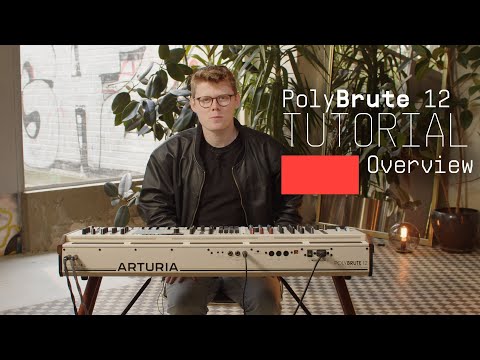
The Arturia PolyBrute 12 builds on the expressive architecture of the original PolyBrute, expanding it into a flagship analogue polysynth focused on articulation as much as sound design. Retaining the dual-oscillator architecture, Steiner-Parker multimode and ladder-style low-pass filters, and deep modulation matrix, it doubles its sibling's polyphony to enable richer layers, wider splits, and more natural polyphonic playing. The defining evolution of the PolyBrute 12, however, lies in the new FullTouch keybed with polyphonic aftertouch, MPE support, and continuous control over each note's movement. The morphing architecture still allows seamless transformation between two fully realised sound states, brought to life through the Morphée controller and direct performance interface – with ribbon control, assignable performance tools, and flexible routing expanding the synth's role across studio and stage environments.
The PolyBrute 12 retains the analogue architecture of its predecessor, centred on dual oscillators per voice with Metalizer wavefolding, PWM, and linear FM. Signals pass through a dual-filter section combining Steiner-Parker multimode and ladder-style low-pass designs, maintaining its established tonal range. The 16×32 modulation matrix continues to provide extensive routing possibilities, enabling complex interactions without sacrificing immediacy. With twelve analogue voices now available, Split and Layer configurations gain greater headroom, unison modes become more expansive, and dense chords can unfold naturally without voice limitation. Rather than altering the core sonic character, the expanded polyphony enhances its practical range, allowing richer textures and more fluid polyphonic performance while maintaining the instrument's analogue identity.
The Arturia PolyBrute 12 expands the performance concept of the original through its FullTouch keybed, introducing polyphonic aftertouch, MPE support, and new articulation possibilities that transform how sounds respond to touch. Each note can evolve independently, for subtle tonal shifts, dynamic swells, or expressive modulation within chords rather than across the entire keyboard. Combined with the morphing system, Morphée controller, ribbon, and assignable performance controls, the instrument encourages continuous interaction rather than static playback. Through the modulation matrix, these controls allow gestures to be mapped to multiple parameters simultaneously in real time. A polyphonic sequencer with automation and a versatile arpeggiator help generate evolving patterns and live experimentation, reinforcing the PolyBrute 12's identity as a performance-focused analogue flagship.
Arturia's success story began with software emulations of well-known analogue synthesizers such as the Moog Minimoog, Sequential Prophet-5, and Oberheim SEM. The popular software instruments included in the V Collection are still flagship products of the French developer today. Over time, Arturia has gradually expanded its range and now also offers a host of hardware devices, ranging from synthesizers and keyboard controllers to sequencers – so that the former software developer has also become a household name in the world of analogue synthesizers and other equipment.
The Arturia PolyBrute 12 adapts confidently to both studio production and live performance environments. Single, Split, and Layer modes benefit from the expanded twelve-voice architecture, making complex voicings, layered textures, and performance-oriented keyboard setups more natural in practice. The built-in polyphonic sequencer records notes alongside parameter movements, while the arpeggiator introduces synchronised rhythmic variation for evolving compositions. USB and MIDI connectivity allow direct integration with DAWs, supported by the PolyBrute Connect software for detailed editing, automation, and preset management. Stereo outputs, analogue clock I/O, and multiple pedal inputs facilitate integration into hybrid rigs, from modular systems to modern production setups. Rather than simply increasing polyphony, the PolyBrute 12 refines the workflow of its predecessor, combining expressive depth with practical flexibility across stage and studio contexts.
FullTouch articulation
Central to the evolution of the PolyBrute 12 is the uniquely expressive FullTouch keyboard: Polyphonic aftertouch and MPE allow each note within a chord to respond independently, enabling subtle swells, vibrato, or tonal shifts on individual voices rather than across the entire sound. Unlike traditional systems that react only at the bottom of a key's travel, FullTouch tracks every keys' full vertical movement, transforming position and pressure into continuous modulation sources. Certain modes even reshape envelope behaviour, allowing articulation and dynamics to be driven directly by touch rather than fixed ADSR curves or external controllers. Combined with the Morphée controller and deep modulation matrix, this creates a performance environment where gestures continuously shape timbre and movement – capabilities rarely found in electronic musical instruments generally, let alone analogue polysynths.