


s
It's a blast
Having spent about two months with it and countless hours of acid and noise techno jamming, this synth is an absolute blast for live performances, including some live patching, transitioning from one soundscape to another and altering the sequence on the fly, for long uninterrupted jams.
The build quality is really well for the price (I expected it to be lower tbh), very nice knobs with enough resistance to not bump some of the very sensitive controls by accident.
There's a few things that are missing imo (they are missing on the original as well) like a reset signal input for the sequencer (and MIDI reset), an LFO (for using a square wave to ratchet the envelopes for example) and maybe a CV mixer/attenuator like the Crave has one but one may say it's those limitations that make it what it is.
Combined with a delay and chorus effect and some live EQ tweaking, one can create truely massive bass lines and hard crunchy noise techno beats and the VCOs go deep enough really get into the meat. Using a 2nd Sequencer to control VCO1 independently from the internal sequencer let's you layer some melodic modulation on top of a punchy percussion sequence, making this even more interesting.
The build quality is really well for the price (I expected it to be lower tbh), very nice knobs with enough resistance to not bump some of the very sensitive controls by accident.
There's a few things that are missing imo (they are missing on the original as well) like a reset signal input for the sequencer (and MIDI reset), an LFO (for using a square wave to ratchet the envelopes for example) and maybe a CV mixer/attenuator like the Crave has one but one may say it's those limitations that make it what it is.
Combined with a delay and chorus effect and some live EQ tweaking, one can create truely massive bass lines and hard crunchy noise techno beats and the VCOs go deep enough really get into the meat. Using a 2nd Sequencer to control VCO1 independently from the internal sequencer let's you layer some melodic modulation on top of a punchy percussion sequence, making this even more interesting.
8
1
Report
6G
I got G.A.S.
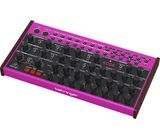
If you know the other product... you'll get [understand] this machine! The bright purple of the Edge will dazzle you at first, but all round it is solid and weighty, as in heavy and in the sound that it makes. I have the [m**g] and use them together! I think they work well and compliment each other! If your looking for something a little different, this could be it and at a reasonable price. Having Midi I/O and a USB port are a good addition to the device, for firmware updates and other settings via the Synth Tribe tool. Add a Crave and Spice up your life... what you waiting for
8
2
Report
P
Patch me if you can!
The Behringer Edge is an exciting synth at its price point, but when paired with the Crave in a setup like mine, it becomes a bit of a logistical nightmare. I built this wooden stand to keep the Edge on top and the Crave below, thinking it would make patching and playing more convenient. Turns out, not so much.
The patchbay placement on the Edge (and of course the crave) right at the top, really works against you in a setup like this. Once you start patching cables, it quickly becomes an entangled mess, making it hard to tweak the knobs underneath. Compared to the Moog DFAM's side-mounted patchbay, this feels like a step backward in usability. I often find myself accidentally pulling cables out or knocking knobs when I’m trying to adjust something.
That said, the sound is nothing short of impressive. The Edge brings a raw, aggressive tone that complements the Crave’s character nicely. Together, they’re capable of creating some wild textures and percussive patterns. However, the workflow isn’t as smooth as it could be, largely due to the Edge’s design quirks.
Feature-wise, the Edge delivers plenty of creative options with its sequencer and modulation possibilities, but the overall experience feels a bit rough around the edges (pun intended). It’s a lot of fun to jam with, especially if you’re into experimental or hard-hitting electronic music, but don’t expect the polish and user-friendly design of the Moog DFAM.
A great budget-friendly entry into the world of semi-modular percussion synths. Just be prepared for some patching headaches if you’re using it in a tight setup like mine. It’s not perfect, but it’s definitely worth the ride.
The patchbay placement on the Edge (and of course the crave) right at the top, really works against you in a setup like this. Once you start patching cables, it quickly becomes an entangled mess, making it hard to tweak the knobs underneath. Compared to the Moog DFAM's side-mounted patchbay, this feels like a step backward in usability. I often find myself accidentally pulling cables out or knocking knobs when I’m trying to adjust something.
That said, the sound is nothing short of impressive. The Edge brings a raw, aggressive tone that complements the Crave’s character nicely. Together, they’re capable of creating some wild textures and percussive patterns. However, the workflow isn’t as smooth as it could be, largely due to the Edge’s design quirks.
Feature-wise, the Edge delivers plenty of creative options with its sequencer and modulation possibilities, but the overall experience feels a bit rough around the edges (pun intended). It’s a lot of fun to jam with, especially if you’re into experimental or hard-hitting electronic music, but don’t expect the polish and user-friendly design of the Moog DFAM.
A great budget-friendly entry into the world of semi-modular percussion synths. Just be prepared for some patching headaches if you’re using it in a tight setup like mine. It’s not perfect, but it’s definitely worth the ride.
2
0
Report
D
Super fun machine
(yes it's a sort of clone from the DFAM, yadda yadda yadda, who cares).
It's a super fun machine to play hand on sequences and industrial drum stuff shenanigans. Yes you can usr it as a drone synth and bass synth (with external keyboard).
To me the fun resides on the "hands on" noise making with external fx to elevate it to a filthy desgusting cacophonous rythm exploitation. YMMV.
I pair it with a Uno Synth Pro X and a Hydrasynth and find it to entertain me to no end. And that's what is all about.
It's a super fun machine to play hand on sequences and industrial drum stuff shenanigans. Yes you can usr it as a drone synth and bass synth (with external keyboard).
To me the fun resides on the "hands on" noise making with external fx to elevate it to a filthy desgusting cacophonous rythm exploitation. YMMV.
I pair it with a Uno Synth Pro X and a Hydrasynth and find it to entertain me to no end. And that's what is all about.
2
1
Report
V
Drummer from another manufacture :)
I’ve been using the Behringer EDGE mainly as a percussion and rhythmic synth in my studio setup, and it has quickly become one of my favorite tools for creating raw, aggressive analog rhythms. It’s clearly inspired by classic West Coast–style designs, but with a modern, very hands-on workflow.
🎛️ Workflow & First Impressions
Right out of the box, the EDGE feels solid and performance-oriented. The layout is very immediate — almost everything important has its own knob, which makes it perfect for live tweaking and improvisation. There’s no menu-diving, and that’s a big plus for a percussive instrument like this.
This is where the EDGE really shines. The sound is punchy, gritty, and very alive. It excels at:
Analog kicks with serious low-end weight
Snappy snares and claps with character
Metallic hits, blips, and FM-style percussion
Experimental, evolving rhythmic textures
The combination of dual oscillators, wavefolding, and resonant low-pass gate behavior makes it easy to go from classic drum sounds to completely broken, industrial-style percussion. It never sounds sterile — there’s always movement and unpredictability.
The built-in step sequencer is simple but effective and works perfectly for rhythmic experimentation. What I really like is how responsive the EDGE is to parameter changes while the sequence is running — it invites constant interaction.
The sync options (MIDI, USB, CV/Gate) make it easy to integrate into a DAW or a modular setup. Clock stability has been solid in my experience.
For its price, the build quality is surprisingly good. Knobs feel firm, buttons respond well, and the overall unit feels reliable for live use. It’s compact but not toy-like.
🎛️ Workflow & First Impressions
Right out of the box, the EDGE feels solid and performance-oriented. The layout is very immediate — almost everything important has its own knob, which makes it perfect for live tweaking and improvisation. There’s no menu-diving, and that’s a big plus for a percussive instrument like this.
This is where the EDGE really shines. The sound is punchy, gritty, and very alive. It excels at:
Analog kicks with serious low-end weight
Snappy snares and claps with character
Metallic hits, blips, and FM-style percussion
Experimental, evolving rhythmic textures
The combination of dual oscillators, wavefolding, and resonant low-pass gate behavior makes it easy to go from classic drum sounds to completely broken, industrial-style percussion. It never sounds sterile — there’s always movement and unpredictability.
The built-in step sequencer is simple but effective and works perfectly for rhythmic experimentation. What I really like is how responsive the EDGE is to parameter changes while the sequence is running — it invites constant interaction.
The sync options (MIDI, USB, CV/Gate) make it easy to integrate into a DAW or a modular setup. Clock stability has been solid in my experience.
For its price, the build quality is surprisingly good. Knobs feel firm, buttons respond well, and the overall unit feels reliable for live use. It’s compact but not toy-like.
0
0
Report
TD
Great addition by Behringer
It was a long wait as I ordered mine at the end of August 2022, when it was briefly available for pre-order. But it was well worth it, already spent quite a few hours on this machine. Sturdy build, good, non-wobbly knobs and excellent sound quality. Couldn't be happier :)
5
1
Report
H
Very inspiring instrument
The EDGE is an incredibly fun and inspiring synth for a very broad range of sounds. I use it mainly for Live Techno Sets. It just shreds such organic sounding grooves effortlessly that work with basically everything you throw at it. Very impressive for the money. Even without using the insane patch matrix you can get a vast range of sounds.
Pros:
-Versatile and fat sound
-Build quality
-Inspiring sequencer
-Price
Cons:
-The knobs. I replaced mine with moog style knobs for about €10.
-Strange VCA out location.
Summary:
Very fun and versatile synth with an unusual sequencer that is just great for happy accidents and inspiration. Shipping and handling from Thomann was great as well. I recommend this synth.
Pros:
-Versatile and fat sound
-Build quality
-Inspiring sequencer
-Price
Cons:
-The knobs. I replaced mine with moog style knobs for about €10.
-Strange VCA out location.
Summary:
Very fun and versatile synth with an unusual sequencer that is just great for happy accidents and inspiration. Shipping and handling from Thomann was great as well. I recommend this synth.
3
0
Report
MP
Absolutely amazing
I was waiting to be good but not that good. Really well constructed that's also sounding amazing!
2
1
Report
P
A good synth
So I have my Edge for over a year now and I can say a thing or two about it.
I really enjoy having my hands on the Edge and play with the individual step volumes and also individual pitch knobs. FM also adds a lot of color into the sound.
The patchbay is ok and the build quality is also good. Same as the Crave.
I'm aware that this is suposed to be a clone, but I find the 1ms or 100ms attack times rather frustrating. Behringer could have put some improvement here, with more attack times. If you have the filter closed, the 1ms attack time of the VCA will give you a click sound that is not always pleasent.
But I do think it's a good synth with great sound and the MIDI implementation does make a difference to sync with DAW. When syncd this way, it's possible to match the bpm and set steps for 1/32, 1/16, 1/16t and so on.
I really enjoy having my hands on the Edge and play with the individual step volumes and also individual pitch knobs. FM also adds a lot of color into the sound.
The patchbay is ok and the build quality is also good. Same as the Crave.
I'm aware that this is suposed to be a clone, but I find the 1ms or 100ms attack times rather frustrating. Behringer could have put some improvement here, with more attack times. If you have the filter closed, the 1ms attack time of the VCA will give you a click sound that is not always pleasent.
But I do think it's a good synth with great sound and the MIDI implementation does make a difference to sync with DAW. When syncd this way, it's possible to match the bpm and set steps for 1/32, 1/16, 1/16t and so on.
0
1
Report
N
Just what i needed
Perfect if you want nasty grit machine. Really good build quality and amazing sound right out of the box!
0
0
Report