


the t.bone PS 100 B-Stock

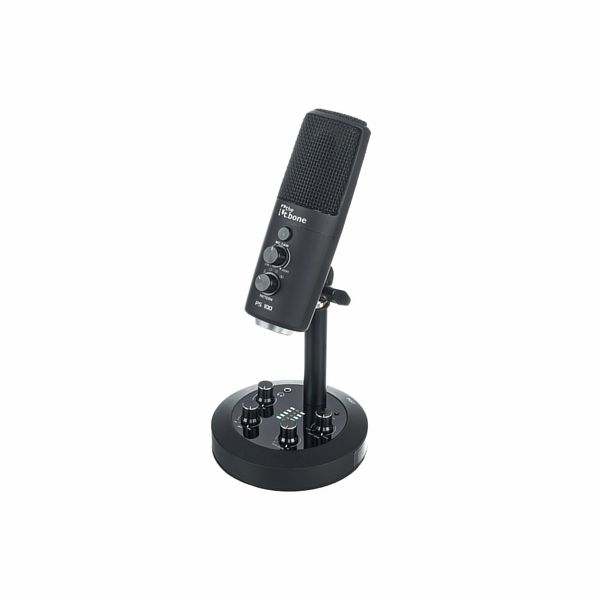
Podcast Station with USB Interface
- Microphone with 3 capsules and switchable characteristics, USB interface integrated in the base and 2-channel mixer
- Controls: Mic Gain, Instrument Gain, Monitor Level, Aux Level, PC/Mic Mix
- Mute switch
- LED display for output and input level
- Selector switch for polar pattern: cardioid, omnidirectional, figure-eight and stereo
- 3 x 16 mm Electret capsules
- Frequency range: 20 - 20,000 Hz
- Sensitivity: -38 dB +/- 3 dB
- Dynamic range: 96 dB
- Max. sound pressure level: 110 dB
- Sample rate: 24 Bit/ 96 kHz
- Dimensions (H x Ø): 253 x 120 mm
- Weight: 1.05 kg
- Colour: Black
- Includes 2 m USB type C to USB type A cable
Connections:
- Instrument input: 6.3 mm jack
- Aux input: 3.5 mm stereo jack
- Headphone output: 3.5 mm stereo jack
- USB type C
Additionally included software (download):
- Cubase LE with 23 VST audio effects
- HALion Sonic SE 3
- Groove Agent SE 5
- Over 5 GB of sounds and loops
-
Available since March 2021
-
Item number 516700
-
Sales Unit 1 piece(s)
Podcasting straight out of the box
The PS 100 Podcast Station from Thomann's in-house brand the t.bone combines a microphone with three capsules and switchable polar patterns with a base that integrates a USB audio interface and a two‑channel mixer. As a result, podcasters and other creators will need no additional hardware to start making recordings – just a USB-compatible device and some editing software. This lightweight plug-and-playability makes the PS-100 ideal for desktop setups where everything is routed through a computer or laptop. Thanks to its 6.3mm jack input, this flexible podcast station can also be used to record instruments, all at a quality of 24‑bit and 96 kHz.
)
All-in-one recording solution
The PS‑100 Podcast Station brings together a microphone, USB audio interface, two‑channel mixer, and desktop stand in a single unit, making it a straightforward solution for podcasters and other creators in the market for an affordable all‑in‑one setup. With its three separate microphone capsules, the PS‑100 offers a choice of different polar patterns, covering everything from solo podcasting through to guest interviews and smaller round‑table recordings. For quick singer‑songwriter sessions, there's also an instrument input, adding another easy way to capture creative ideas without additional gear. A built‑in LED meter provides a constant overview of input and output levels, while the PC/mic mix control makes it easier to hear how the speakers' voices sound within the overall mix – without affecting the signal that's actually being recorded.
)
On the technical side
The PS‑100's three 16 mm electret capsules sit behind a metal grille, which protects them from damage; they can handle sound pressure levels of up to 110dB, offer a dynamic range of 96dB, and cover a frequency response that's quoted at 20Hz to 20kHz. On the front of the microphone itself, there's a mute switch, a mic gain control, and a selector for the polar patterns – cardioid, omnidirectional, figure‑of‑eight, and stereo. The base houses a five‑step LED level meter along with four additional controls for instrument gain, monitor level, AUX level, and the PC‑mic mix. Above the controls, or recessed into the rear of the unit, are the connections: a 6.3mm instrument input, a 3.5mm AUX input, a 3.5mm headphone output, and the USB‑C port.
)
About the t.tbone
Since 1994, the t.bone has been one of Thomann's in-house brands, and its name can be found on devices such as headphones, wireless systems, in-ear equipment, and various microphones and matching accessories. the t.bone products are made exclusively by renowned companies who also manufacture products for other well-known brands. This provides a clear advantage: Brand-quality products at very reasonable prices. And word gets around: One in seven Thomann customers has already bought at least one product from the t.bone.
Get creative with your ideas
Thanks to its suprisingly comprehensive technical feature set, the PS‑100 Podcast Station from the t.bone is much more than a simple USB mic with a gain control. Instead, it replaces an entire two‑channel recording interface, complete with an instrument input, LED level metering, a range of fine-tuning options, and an individually adjustable monitoring mix. The device is clearly designed for use at desktop workstations, where it's ideally suited to speech recordings. Beyond that, though, the PS‑100 also works well for vocal demos, sketching out new tracks, and instrumental recordings. Simply connect it to a laptop or computer using the USB cable it ships with, and start turning those ideas into reality.
