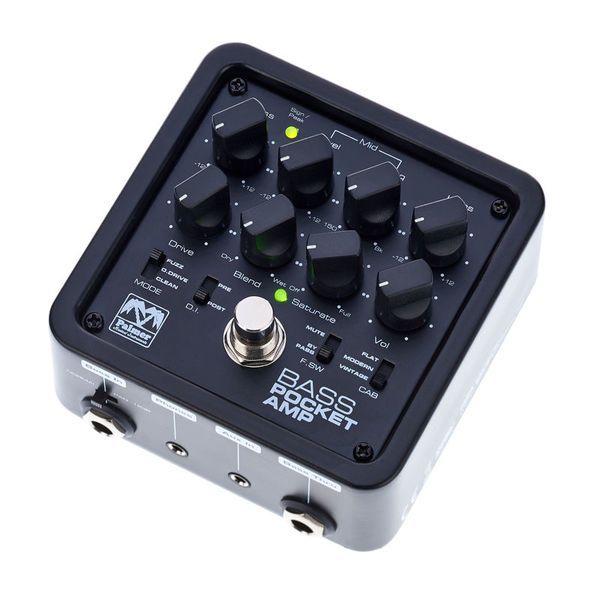
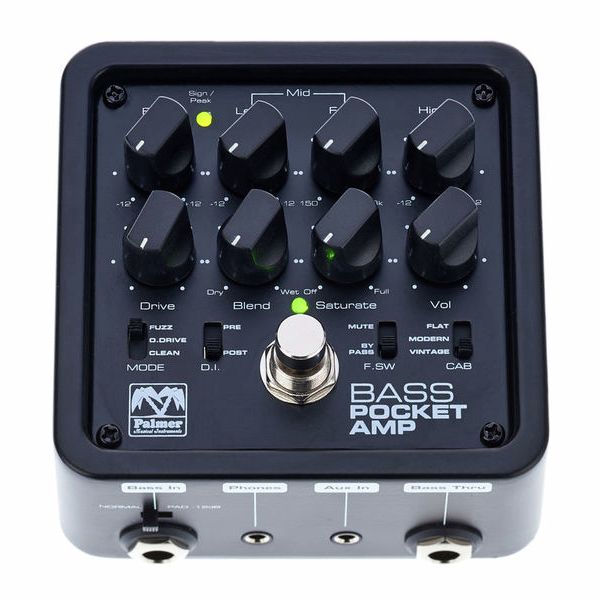
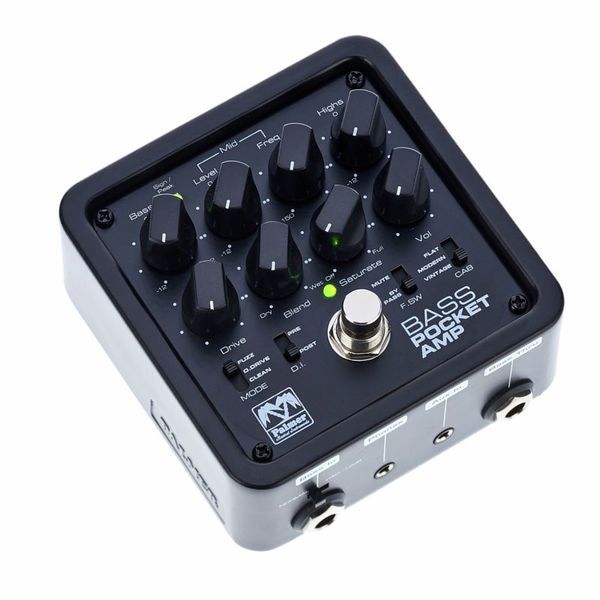
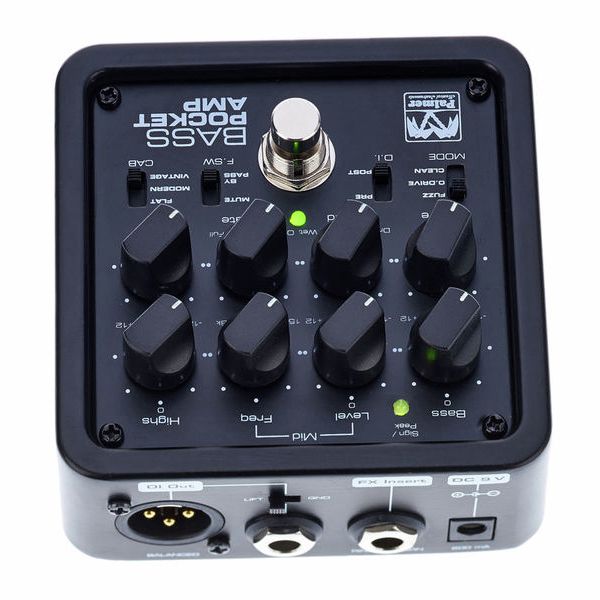
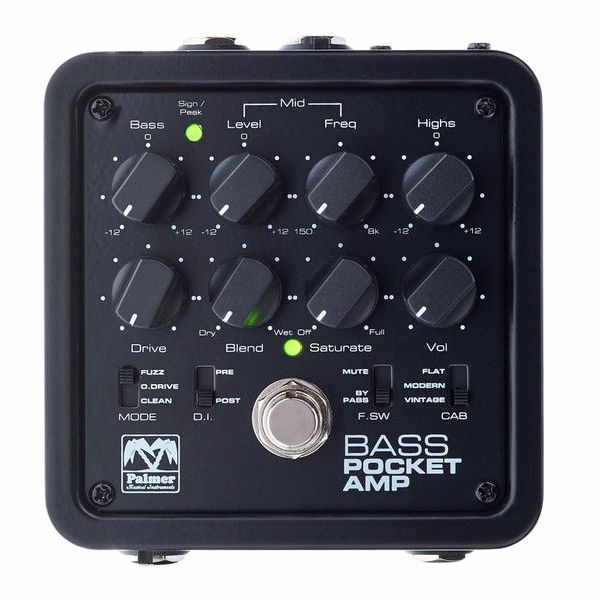
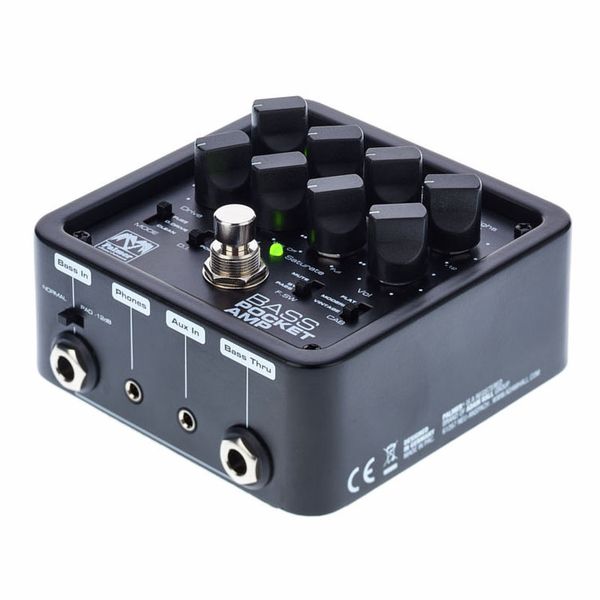
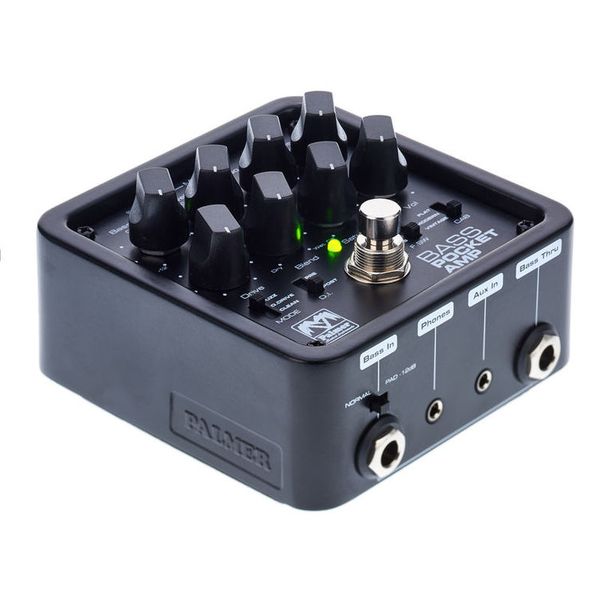
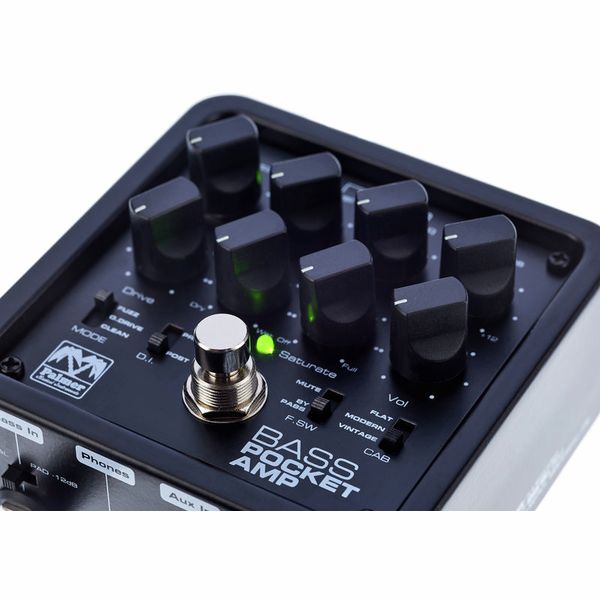
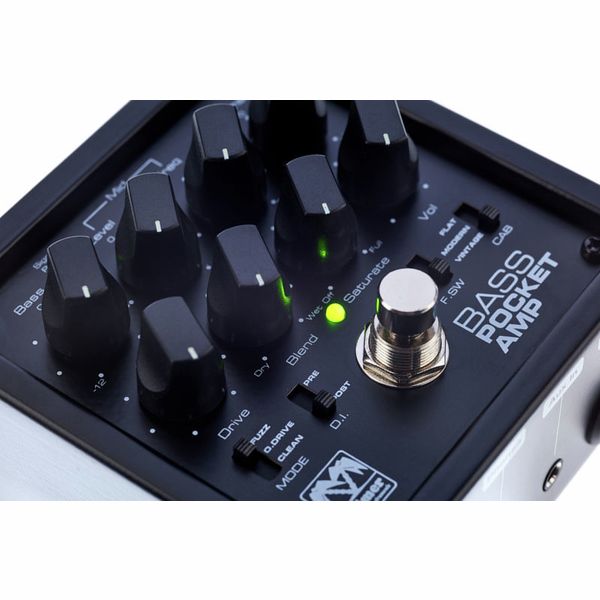
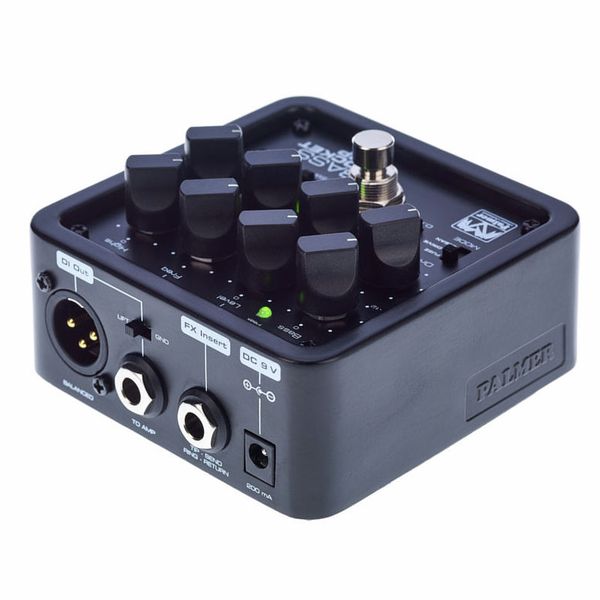
This is a compact, versatile DI preamp pedal serving many use cases relevant to bass practice and performing. Offerings from other brands such as Darkglass, Ampeg, Sansamp etc. may be more enticing with specific house sound and proprietary features, but they’re also costly, whereas the Palmer is a cost-effective, somewhat neutral and reliable swiss-army-knife of a pedal.
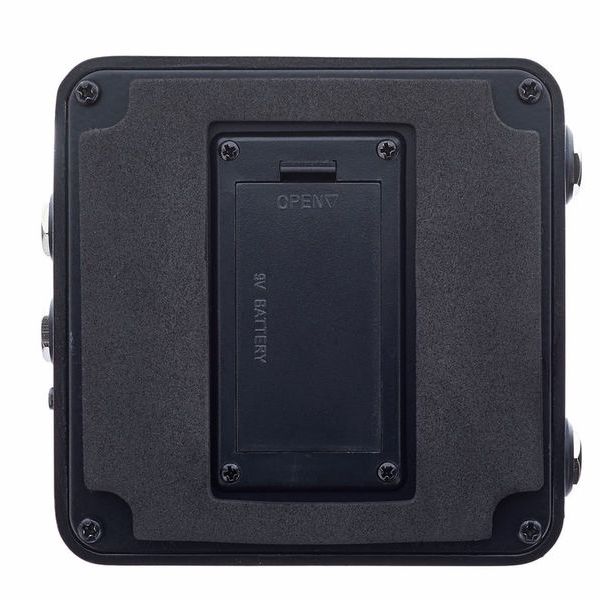
Besides being a mains-powered, active DI preamp box for a pedal board or amp/combo amp, it’s also a handy battery-powered portable headphone amp for practicing on the go or in silence. With numerous outputs, it functions as a buffered signal splitter for live and recording scenarios.
Pros:
- Portable and sturdy.
- Good EQ/preamp, sweepable Mid-frequency knob covering huge range.
- I/O for signal splitting.
- Headphone out for practice.
Cons:
- Documentation could be more thorough.
- Ports are precisely machined but not smooth to plug in.
- Pops when plugging/unplugging jacks.
- Aux-in volume is controlled entirely by source.
- No USB-out for use as an interface, nor bluetooth capabilities for wireless headphones or aux-in audio.
Notes:
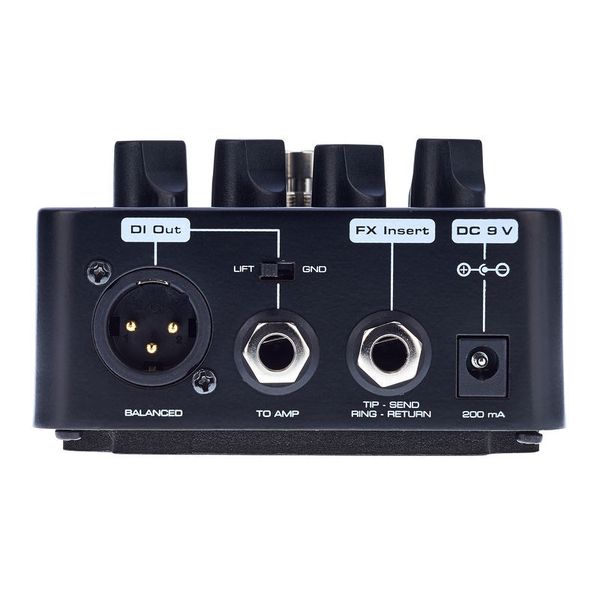
- Signal level of the DI XLR Out, ¼" TRS Out, and the Thru Out, are all different. DI XLR Out: +4DBU and 510 Ohm, ¼” TRS Out: 0DBV and 10k Ohm; Thru Out’s specs not specified but I’m guessing they are equal to the instrument itself plus length of cable. Signal level of the DI XLR Out and ¼” TRS Out are attenuated by the Volume knob.
- ¼” TRS Out is electrically isolated from DI XLR Out and parallel; note that it isn't affected by the pre-/post- switch that controls whether the DI XLR Out carries the signal from before or after the pedal’s circuitry. Hence the ¼” TRS Out will always carry the post- signal modified by EQ/overdrive/cab sim.
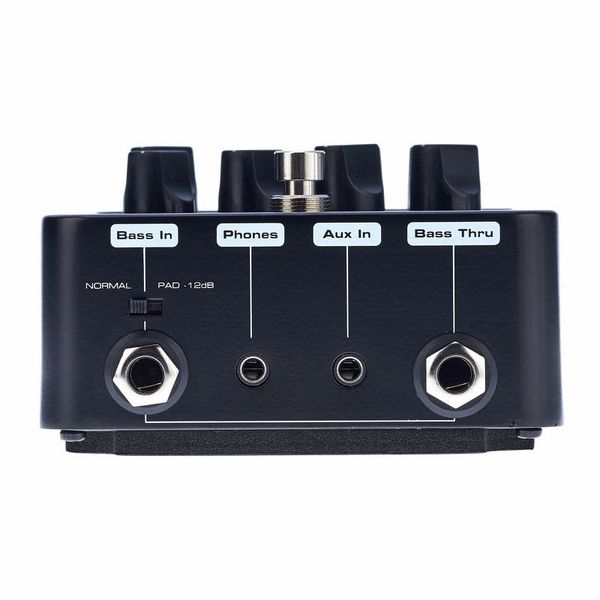
- Thru Out is unaffected by the pedal’s circuitry and always active, useful for a tuner pedal or for sending a clean unprocessed signal to another amp or interface. As it is true unbuffered bypass the quality may sound, accordingly, sterile and thin and much lower in volume. Myself having a bass with passive pickups sensitive to load, I placed the Korg Pitchblack XS Bass tuner right after the bass and before the Palmer; accordingly with this buffer in place, the tone out of the Palmer’s Thru was deep and bright.
- FX-Loop is a single port requiring an uncommon Y-cable with both the send and return - inconvenient but economical use of space. Better documentation of the internal signal chain would have helped understanding where the FX loop lies, for deciding what pedals would be best suited being inside the loop as opposed to adjacent to the Palmer.
- Footswitch’s mode selector lets you either bypass the pedal, or mute the signal going out of DI XLR or ¼” TRS Out. Bypass sounds great to my ear, identical to the processed signal; probably buffered.
- Aside from the LED for mute/bypassed, a second LED glows green to indicate nominal level, amber for proximity to clipping, and red for clipping. Pad switch comes in handy to attenuate the input by -12dB.
- 3-band EQ knobs, each having both cut and boost capability, comprise a solid preamp section. Mid knob has an accompanying frequency sweeper which lets you specify exactly which Mid frequency you would like to attenuate. The remarkably wide frequency range of the sweeper going from as low as 150Hz all the way up to 8kHz seems to be somewhat unusual and makes it useful not just for bass but for guitar too. This definitely sets the Palmer apart from any of the other DI preamp pedals out there.
- Headphones Out signal is stereo. Output impedance of the port is not documented but it is able to drive both my high-impedance Sennheiser HD 6XX and low-impedance Koss Porta Pros transparently with ease.
- No controls for Aux-in, so take care to control the volume from the input device.
- No measures taken in the circuitry to minimize pops from connecting/disconnecting plugs, a rare oversight in the design and implementation. As a result, these pops can be very loud and potentially damaging for connected devices.
- Overdrive and Fuzz are nice to have if unremarkable. Aside from portable convenience, they work well with the Drive and Saturation knobs. On both bass and guitar, I like the overdrive only lightly driven, giving some dirt and midrange warmth helping to accentuate the growl from my soloed bridge pickups. Fuzz is somewhat sensitive to the power; hence sometimes when battery-powered it’s weak and intermittent, whereas when mains-powered it’s much more full-sounding and reliable.
- Saturation is one of the less documented and understood features of the Palmer with a tape saturation effect most noticeable used with overdrive and fuzz, plus possibly some limiter functionality.
- Alongside the standard Flat setting, “Vintage” and “Modern” amp sims are somewhat understated but useful even if you have other equipment fulfilling the same purpose. Compared to my Boss combo amp’s sim, the Palmer’s Modern is more desirable sometimes with its more dusky and less shimmery presentation.
- Sims add character to the Palmer which may have otherwise not been felt, being mostly a preamp pedal from a brand known for its clean power utilities and transparent DI boxes as opposed to effects pedals, hence lacking a specific house sound other pedals may have. I did reach out directly to Adam Hall, owners of the Palmer brand, inquiring about the internals and whether it shared any tech with the other DI boxes in its catalog. The reply, while prompt and gracious, was lacking in specifics.
- Power supply must be purchased separately. Ground Lift is handy to eliminate ground loops; as always treat that with care when connecting numerous instruments. The Boss PSA 230S is adequate for sufficient, noiseless power; even when powering both the Korg Pitchblack and the Palmer in daisy chain, it remained noiseless with performance unaffected.