To the page content

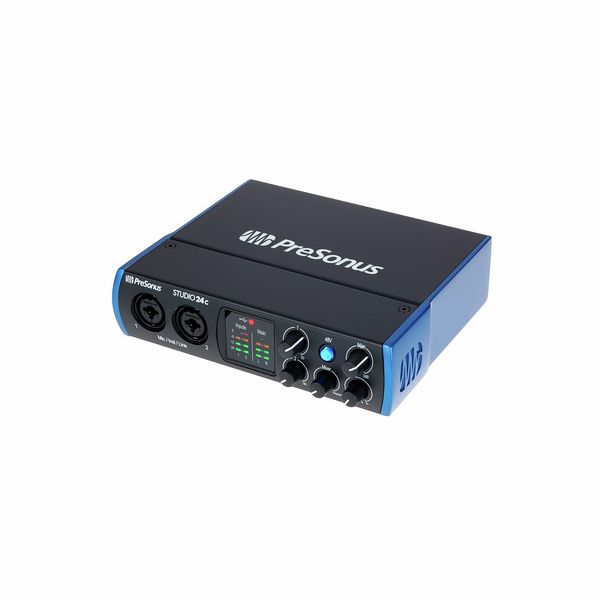
Presonus Studio 24c B-Stock

iZotope Ozone 12 Elements for free

iZotope Ozone 12 Elements for free

Up to and including 15.01.2026 when you buy one of the participating products you get iZotope Ozone 12 Elements worth EUR 59,00 for free on top.

B-Stock with Full Warranty
Return that may have slight traces of use.

USB-C 2x2 Audio Interface

  • 24 Bit / 192 KHz
  • Two front combo inputs Mic/Line/Inst: XLR/jack
  • 48 V phantom power
  • Two XMAX L mic preamps
  • Two balanced TRS main outputs with front panel level control
  • DC-coupled line outputs allow CV/Gate signals to be sent out of the DAW
  • Stereo headphone output
  • LED level indicators - two inputs, two main outputs
  • MIDI In and Out
  • Latency-free monitoring
  • Bus powered
  • Compatible with Windows 7 or later, Mac OSX 10.11 or later
  • Dimensions (H x W x D): 44 x 180 x 144 mm
  • System requirements Interface: Windows 10 or later, Mac OSX 10.11 or later
  • Weight: 0.9 kg
  • Including Studio One Artist (download)
  • Available since February 2019
  • Item number 464940
  • Sales Unit 1 piece(s)
  • Recording / Playback Channels 2x2
  • Number of Mic Inputs 2
  • Number of Line Inputs 2
  • Instrument Inputs 2
  • Number of Line Outs 2
  • Headphone Outs 1
  • Phantom power Yes
  • Number of S/PDIF Connectors 0
  • Number of ADAT Connectors 0
  • Numer of AES/EBU Connectors 0
  • Number of MADI Connectors 0
  • Ethernet 0
  • Other Connectors No
  • MIDI interface Yes
  • Word Clock No
  • Max. sample rate (kHz) 192 kHz
  • Max. resolution in bit 24 bit
  • USB Bus-Powered Yes
  • Incl. power supply No
  • USB Version 2.0
  • Width in mm 180 mm
  • Depth in mm 144 mm
  • Height in mm 44 mm
  • Connection Format USB port Type C
  • Included in delivery incl. USB-C to USB-C and USB-C to USB-A Cable
  • Zero latency monitoring Yes
$90
The shipping costs are calculated on the checkout page.
In stock

Portable USB-C audio interface

The Presonus Studio 24c is a 2-in/2-out audio interface with a USB-C connection that can be operated with Windows 7 and above and macOS from version 10.11 onwards. Two input signals can be processed simultenaously, and the two XLR/jack combo sockets on the front of the interface can be used to connect not only microphones and keyboards but also stringed instruments with high-impedance outputs such as electric guitars and electric basses (the interface automatically adjusts the input impedance). Another very practical feature is the integrated MIDI interface, to which external controllers, keyboards, and drum pads can be connected. To allow the user to get started straight away, the scope of delivery additionally includes two USB cables and the StudioOne Artist software.

Controls on the Presonus Studio 24c USB-C 2x2 Audio Interface

Plug-and-play at its finest

The Presonus Studio 24c is USB-powered, which allows the compact interface to be operated on the go, and its two four-segment LED meters allow visual monitoring of the input and output levels on the unit itself. The monitor control lets the user seamlessly adjust the ratio between the input signals and the DAW playback signal, allowing the latency-free monitor signal to be conveniently regulated directly on the unit without having to reach for the mouse or keyboard. Switchable phantom power for condenser microphones is also provided, which can be activated for both channels using the dedicated button on the front of the unit. The Studio 24c has separate volume controls for its line and headphone outputs, which is practical because experience shows that musicians need a louder monitoring level than sound engineers would like. The headphone output is definitely loud enough, however, as it goes up to eleven.

Connections on the Presonus Studio 24c USB-C 2x2 Audio Interface

A two-channel studio

The term "studio" in the Presonus Studio 24c's name does a lot more than simply describe its appearance: Anyone who can get by with two high-quality channels can build a small but impressive recording or home studio with this USB audio interface. In many cases, two channels are sufficient for everyday studio use, and the Presonus Studio 24c packs these two channels into a compact format and delivers an impressively high-quality sound thanks to its 24-bit converter resolution and 192kHz sample rate. Worthy of note is also the fact that this interface features the same excellent-sounding XMAX-L microphone preamps as Presonus uses in its high-end digital consoles, and as mentioned above the Studio 24c can be powered via the USB socket and is therefore also suitable for mobile use.

Inputs on the Presonus Studio 24c USB-C 2x2 Audio Interface

About Presonus

Presonus is a US company founded in 1995 by Jim Odom and Brian Smith in Baton Rouge, Lousiana. The firm designs hardware and software at both professional and more affordable levels for musicians and producers. Presonus first made a splash in the mid-1990s with the DCP8, an eight-channel analogue compressor/limiter/gate with fader and mute automation that could be digitally controlled by MIDI. In the early 2000s followed a series of microphone amplifiers and the first audio interfaces for the then-emerging home studio scene. Today, the company's product range includes audio interfaces, microphone preamps, digital mixing consoles, and studio monitors as well as the established DAW software Studio One.

A creative tool for on the go

The Presonus Studio 24c gives users who don't need more than two channels a portable creative tool for all kinds of applications. The interface is compact enough that singer-songwriters can easily take it to gigs or capture ideas on the go, and the sound quality is sufficient for recordings that can even be used in professional production environments. Musicians can record vocals and guitar or keyboard at the same time thanks to the Presonus Studio 24c's two-channel design and thus refine their ideas in the Studio One Artist software with virtual instruments and effects. In addition, the Studio 24c gives users everything they need to record musicians or speakers in a separate recording room, for example, making this interface ideal as the central element of a compact home studio setup.