


Sequential Fourm




One month of full access to Syntorial for free – learn synth programming like a video game
When you purchase this product between 15.07.2026 and 15.10.2026, you receive a free 30-day full trial of Syntorial, the interactive ear-training software for synth programming.
Instead of just watching videos, you recreate leads, basses, pads and more. Get instant feedback as you learn how oscillators, filters, modulation and effects work together to create real patches.
Your personal voucher code will be sent automatically by e-mail after your order. No credit card required. The trial ends automatically after expiry.
This offer is available in English, French, Spanish, and Japanese.
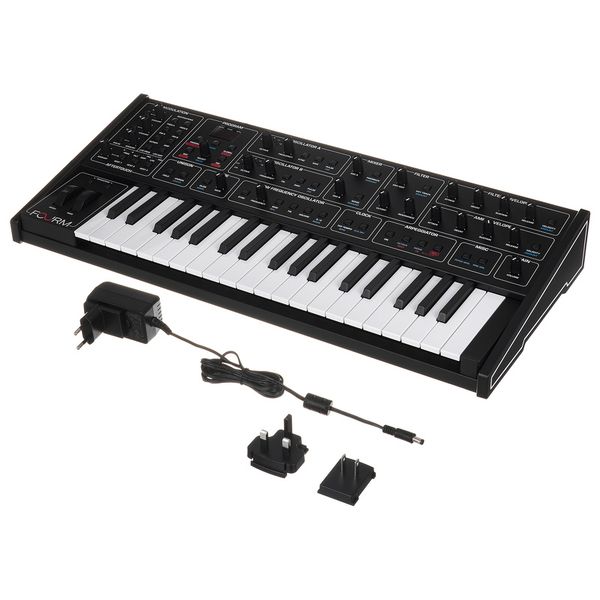
Analogue Synthesizer
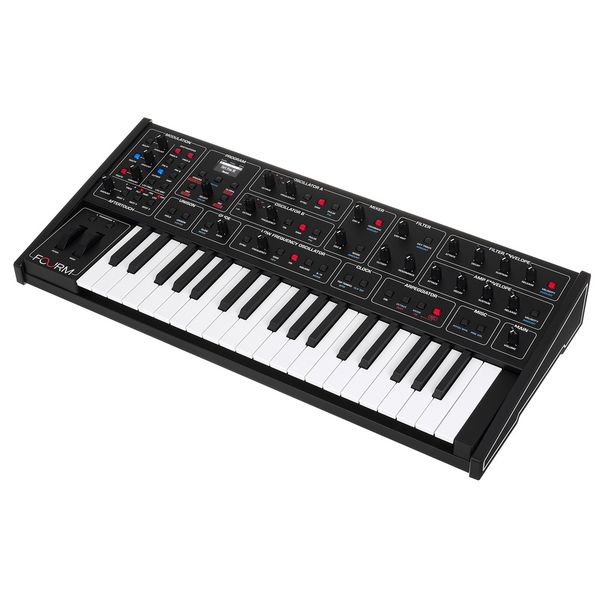
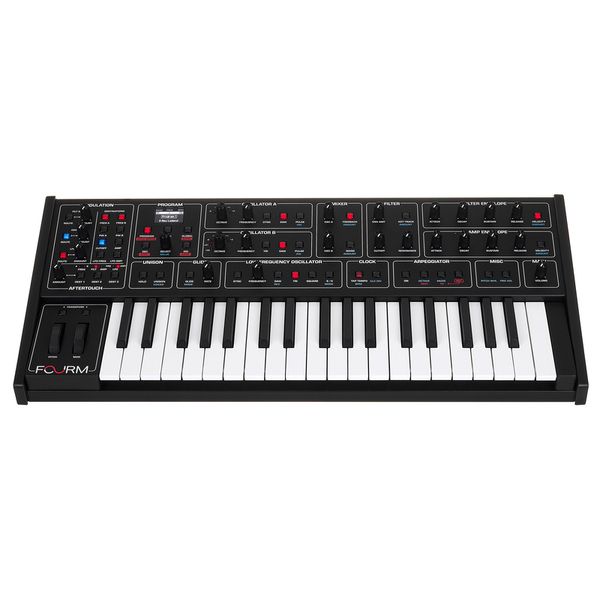
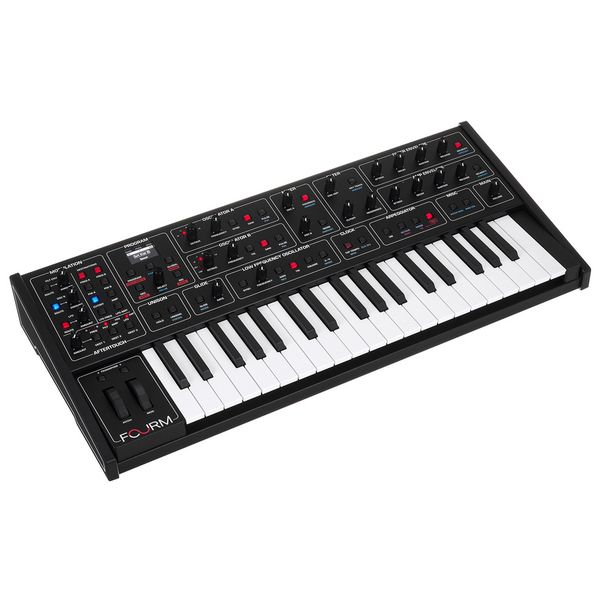
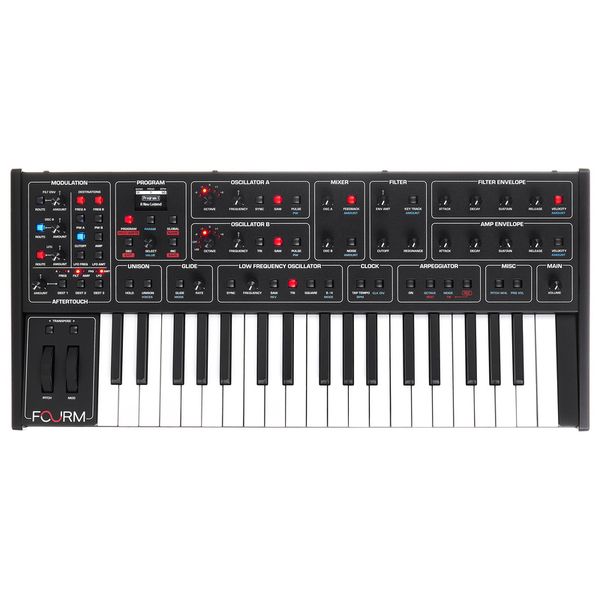
- Four voice
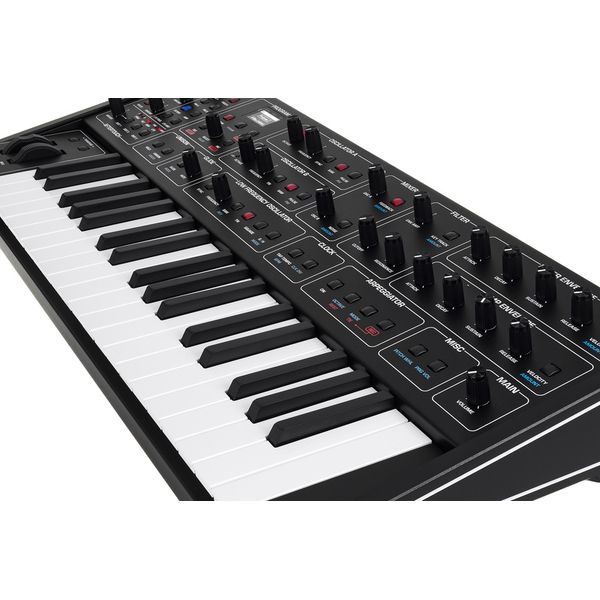
- 37 slim keys with polyphonic aftertouch
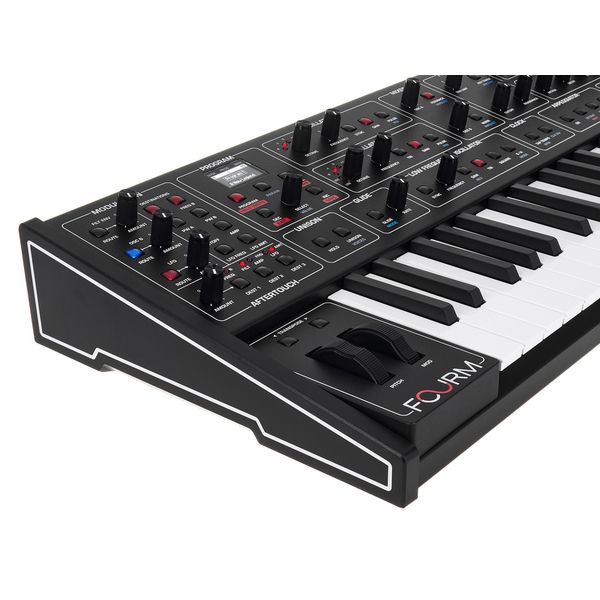
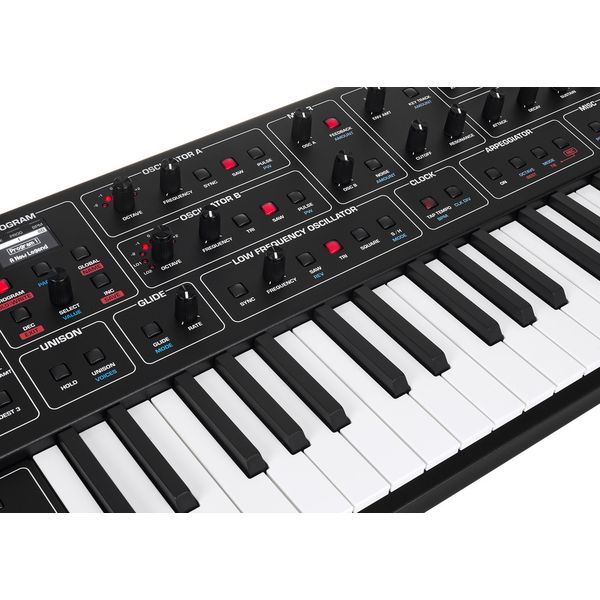
- Pro-One-style modulation matrix
- Resonance filter from the Prophet line with bass compensation
- Arpeggiator with sequencer mode
- 128 presets
- All oscillators and LFOs have simultaneously selectable waveforms
- Oscillator B supports low-frequency modes
- Classic Prophet-style synchronisation
- 4-pole resonant low-pass filter
- Feedback with aggressive ‘drive circuit’
- Two ADSR envelopes
- Sequencer supports 'glide per step'
- Display
- Pitch and modulation wheel
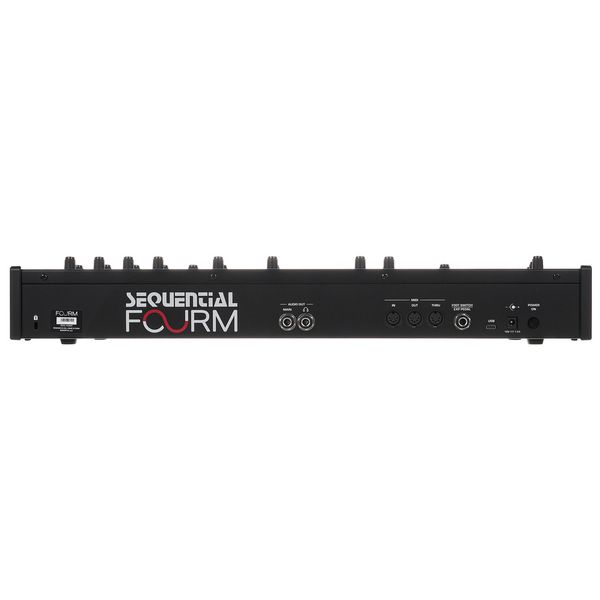
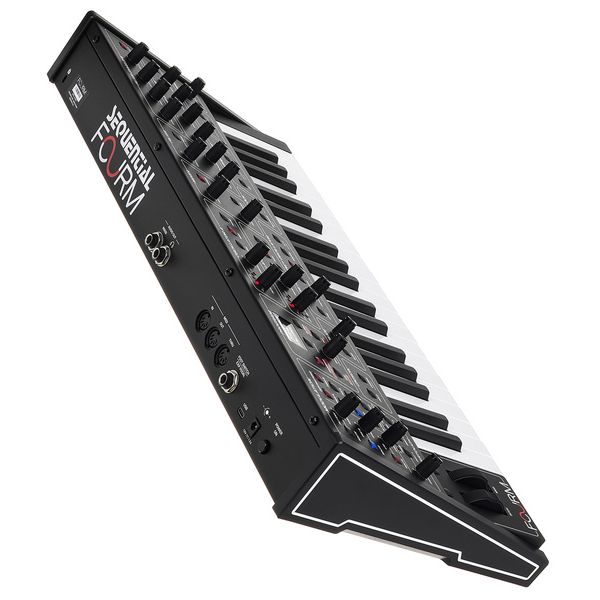
- Anti-theft slot
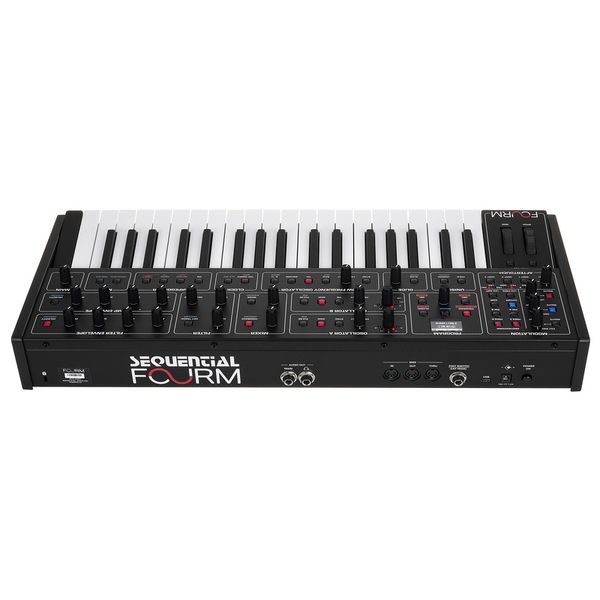
- Mono line output: 6.3 mm jack
- Mono headphone output: 6.3 mm jack
- MIDI in/out
- USB
- Connector for footswitch/expression pedal
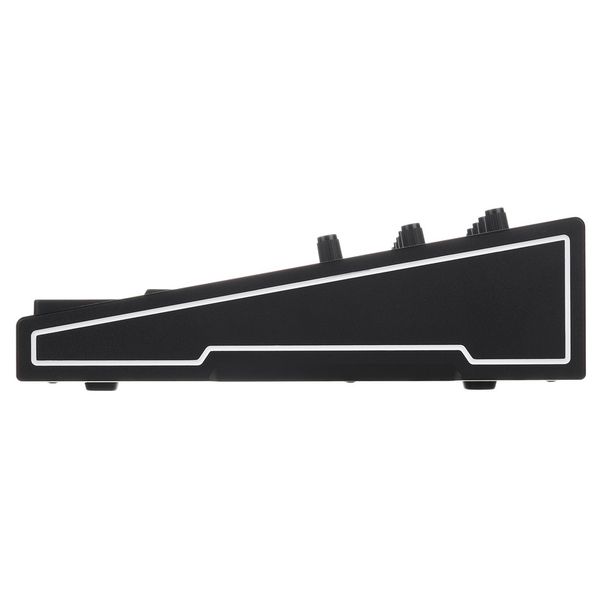
- Housing material: Steel
- Dimensions (W x D x H): 562 x 251 x 70 mm
- Weight: 3.97 kg
- Includes external power supply
-
Available since September 2025
-
Item number 622033
-
Sales Unit 1 piece(s)
-
Number Of Keys 37
-
Touch-Sensitive Yes
-
Aftertouch Yes
-
Split Zones No
-
Modulation Wheel Yes
-
Number of simultaneous Voices 4
-
Sound Engine Analogue
-
MIDI interface 1x In, 1x Out, 1x Thru
-
Storage Medium Internal
-
USB-port Yes
-
Effects None
-
Arpeggiator Yes
-
Number of Analog Outputs 2
-
Digital Output No
-
Display Yes
-
Pedal Connections 1
-
Dimensions 562 x 251 x 70 mm
-
Weight 4,0 kg
-

Fourm follows function
Classic vintage synthesizers like the legendary Sequential Prophet 5 have always stood out because of their sound, but also because of their considerable dimensions which, while visually impressive, don't make for easy transportation. Thanks to modern technology, however, polyphonic analogue synths can now pack the same features and more into a significantly smaller footprint. Enter the Sequential Fourm, which features the same tried-and-trusted sound generation structure and familiar user interface, while also adding a Pro One-style modulation matrix: All this is served up in a much smaller package than its vintage ancestor, to which this synth is a worthy successor. Its sturdy metal chassis and mini-keyboard with polyphonic aftertouch make the Fourm a roadworthy instrument that will deliver the goods in any live environment, combining the sounds of the vintage era with the advantages of cutting edge technology.

)
Four-voice analogue synth
The Sequential Fourm's sound generation is based on that of the classic Prophet 5 model: All of the waveforms can be active at once on both VCOs, and the Prophet's distinctive Sync is also on board. The classic four-pole low-pass filter circuit has been enhanced by the addition of a bass compensation feature that allows the low-end to be faithfully retained even at high resonance, while the aggressive drive circuit provides adjustable feedback for some extra edge. What is more, the Fourm's assignable modulation allows the player to make rapid changeovers even during live performances, and a footswitch or a pedal can also be connected for enhanced control. Embedded in the onboard arpeggiator is a sequencer mode that allows glide to be set for each step, in addition to which the Fourm's polyphonic Unison mode lets all four voices be played at once – for extra-powerful bass or punchy lead sounds.
)
Prophet 5 minus 1
The Sequential Fourm gives fans of those signature analogue sounds a synth that combines the classic instrument structure with a practical feature set. The keyboard's compact dimensions and manageable weight of just 4kg make it easy to carry and transport to gig venues, to rehearsals, and from one studio to another without unnecessary strain. The strong similarity that the Fourm bears to the Prophet 5 also means musicians won't need a long time to get used to it, and with 128 pre-programmed presets they can start playing right away anyway. The whole range of parameters are directly accessible to allow sounds to be edited easily, while the modulation matrix even allows on-the-fly adjustments to be made. Musicians who prefer a larger keyboard can connect the Fourm to a controller keyboard via the MIDI input or the USB port, or they can control it directly from their DAW.
)
About Sequential
Dave Smith, founder of Sequential Circuits (1974-1987), is a major pioneer in the world of synthesizers. His Prophet-5 was the world's first polyphonic synthesiser to enable the storage of parameters. It was followed by innovations such as the Prophet T8, Prophet VS and samplers. Smith was also a major initiator of the MIDI standard and was also deeply involved in the development of the first virtual synthesizers. In 2002, he founded Dave Smith Instruments and has since been one of the most successful suppliers of analog and hybrid hardware synthesizers. Since 2018, the company has been operating under the name Sequential once more.
King of the keyboard hill
Sequential has primarily designed the Fourm to create monophonic and polyphonic solo sounds, rather than to function as the centrepiece of a synthesizer setup. As long as they don't need more than four voices, players can thus use the Fourm to generate impressive soundscapes with that typical analogue flair. The synth's compact dimensions mean that, if a larger setup already includes one or more keyboards, the Fourm is best placed at the top of the rig (or on top of another piece of equipment, if it's large enough), so it can be played without the other keyboards getting in the way. Incidentally, the onboard arpeggiator is not just a nice afterthought: It also allows the player to program patterns with rests, ties, and glides for each step, which means the Fourm is also capable of basslines reminiscent of the 303 synth as well as Electro-style sequences.