
To the page content
B-Stock with Full Warranty
Return that may have slight traces of use.

Condenser Microphone

  • Cardioid characteristic
  • Phantom power +48V required to operate
  • XLR connector
  • Impedance 200 Ohm
  • 107 dB SPL
  • Frequency range: 20 - 20 000 Hz (0.1m -10 dB)
  • Sensitivity: -35 dB
  • Weight: 180 g
  • Incl. windscreen
  • Available since July 2001
  • Item number 290103
  • Sales Unit 1 piece(s)
Also available as brand new product $44
$41
The shipping costs are calculated on the checkout page.
In stock
1

A budget condenser microphone

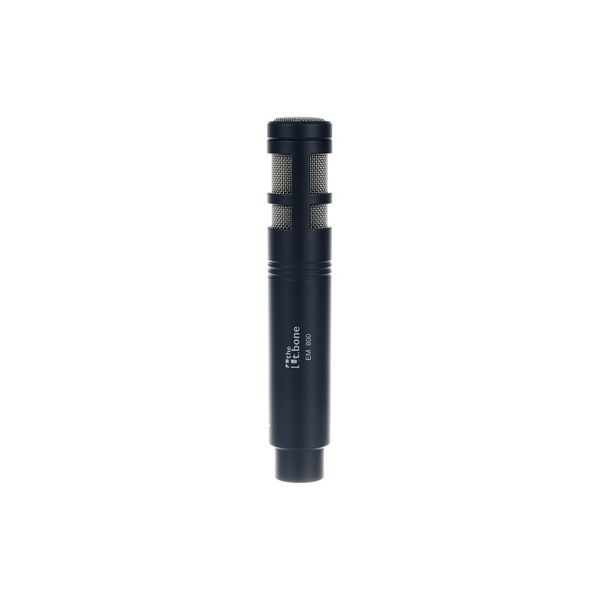
The t.bone EM 800 is a condenser microphone that comes at a very beginner-friendly price, which alone makes it quite remarkable. However, what really sets it apart is the fact that the EM 800 covers the entire audible range of human hearing. Users who keep their expectations of a budget microphone within reasonable limits will be more than pleased with their EM 800, as its cardioid polar pattern strikes a successful balance between rear sound shielding and lateral flexibility when compared to supercardioid and omnidirectional models. The scope of delivery here also includes a microphone stand clip, a wind shield, and a transport case.

the t.bone EM 800 small-diaphragm condenser microphone

As far as the ear can hear

The t.bone EM 800 connects to a mixer or recorder via an XLR socket and, being a condenser microphone, requires 48V phantom power to operate. The mic can handle up to 107dBSPL and its frequency response is remarkable, as it is identical to the range of human hearing, from 20Hz to 20kHz. As can be seen from the frequency diagram, the curve rises slightly between 20Hz and 500Hz, and it then remains almost linear before dropping off sharply after a slight treble boost. Measured at 1kHz, the cardioid polar pattern of the t.bone EM 800 boasts optimum characteristics and thus ensures consistent recordings and excellent live performance.

Small diaphragm condenser microphone - detailed view

Get in and get going

For anyone looking for a flexible and budget-friendly microphone for their first performance or recording session, a t.bone EM 800 is an excellent choice. This tried-and-tested tool produces the familiar sound of a condenser capsule, and is suitable for different instruments: Drummers can use the EM 800's cardioid polar pattern to effectively mic up their drumkit's cymbals, but it's equally at home with other percussion instruments, the acoustic guitar, or flute. It's at concerts, though, where the polar pattern is at its most effective, because it isn't susceptible to ambient sounds from behind. The EM 800 is also ideal for podcasts and vocal recordings in a home studio, while inexperienced presenters will also be delighted to find out that the EM 800 delivers great results even when speaking slightly off-centre.

Condenser microfone by the t.bone

About the t.bone

Since 1994, the t.bone has been one of Thomann's in-house brands, and its name can be found on devices such as headphones, wireless systems, in-ear equipment, and various microphones and matching accessories. "the t.bone" products are made exclusively by renowned companies who also manufacture products for other well-known brands. This provides a clear advantage: Brand-quality products at very reasonable prices. And word gets around: One in seven Thomann customers has already bought at least one product from the t.bone.

For those first live gigs and recordings

To get started with their new t.bone EM 800, users need to activate the phantom power on the input to which they are connecting the microphone. At a gig, this is located on the live mixer, whereas when recording, it can be found on the recording equipment itself. The audio signal enters the console via a standard cable (the sssnake's SM10 BK microphone cable being just one excellent example here), and the final step is to position the microphone using the included clip. The Millenium MS-2003 is an affordable choice of microphone stand: Of course, there is an endless range of similar products, but apart from being useful for singers and speakers, the boom on the MS-2003 allows instruments to be miked up flexibly from the side or above, with the height minutely adjustable for this very purpose.

43 Customer ratings

4.4 / 5

features

sound

quality

43 Reviews

google translate de
Unfortunately there was an error. Please try again later.
TR
Atmo-Mikro der robusten Klasse
Thomas R. 13.10.2009
Ich nutze jetzt seit vielen Monaten das T-Bone EM 800 an allen meinen Video-Kameras als Atmo-Mikrofon. Damit erziele ich erstaunliche Ergebnisse bei der Aufzeichnung auf HDV-Bandmaterial mit der HVD-Kamera Z1 von Sony. Das Mikrofon ist von enormer Robustheit und hat bereits Wüsteneinsätze bei Temperaturen bis zu 50 Grad Celsius hinter sich gebracht und ist oft genug bei Einsätzen einer Umweltschutzorganisation im Schlauchboot dabei gewesen. Bis heute habe ich dieses Mikrofon nicht kaputt gekriegt was mir mit den 5-10mal teureren Mikros von Sony oder Sennheiser mühelos mindestens einmal im Jahr gelingt.
Besonders interessant: In einem Kriegsgebiet hielten Rebellen das EM800 mal für ein Geschoß der besonderen Art. Lediglich der XLR-Anschluß gab ihnen zu denken und so wurde es nicht mit einer Kanone verfeuert. ich bin mir allerdings sicher, das es beim EInschlag am Ziel verheerende Wirkung gezeigt hatte.
Fazit: Robust, funktionsverlässig, günstig! Kaufen und Anweden!
features
sound
quality
39
6
Report

Report

google translate de
Unfortunately there was an error. Please try again later.
V
Klein-Stark-Sicher-Günstig
VolkerD 26.10.2009
Tja, mit dem EM 800 hab ich endlich ein Mikrofon gefunden, das für meine Anwendungsgebiete ein gute Wahl darstellt. Egal ob für reine Sprachübertragung am Rednerpult - bei unterschiedlichen Sprechabständen keine Probleme. Oder für die Abnahme vom Chorgesang - dank der geringen Größe auch optisch ein dankbares Mikro.

Und gerade bei den weniger "voluminösen" Chören, mit denen ich es meist zu tun habe, zeigt es seine Leistungsfähigkeit. Dank äußerst geringer Rückkopplungsneigung kann man den Chor auch in größeren Räumen (Kirchen) noch gut verstärken. Es ist immer ein tolles Erlebnis, wenn sich die Kids bemühen und es dann mit etwas Technikeinsatz möglich ist, dies auch "rüber-zu-bringen".
Auch für die Abnahme von akustischen Instrumente (Gitarre, Flöten, ...) konnte ich meine (inzwischen drei) EM 800 einsetzen und machte sehr gute Erfahrungen damit - sowohl beim Klang als auch bei Rückkopplungsicherheit und Bedienung.

Klein-Stark-Sicher-Günstig So würde ich meine Erfahrungen kurz umschreiben.Ach ja, auch die Mikrohalterung ist für Überkopfeinsatz recht praktisch - sie hält das Mikro nämlich ziemlich sicher - ist ja nicht bei allen der Fall!
features
sound
quality
19
1
Report

Report

google translate de
Unfortunately there was an error. Please try again later.
D
Für das Geld echt gut.
DrumS. 27.04.2011
Das THE T.BONE EM 800 ist etwas größer als normale Overheads die mir bekannt waren und sind. Ich nutze es mit einer Halteschiene von unten auf das Ride gerichtet als zusätzliche abnahme für dieses. XLR Kabel dran ins Pult, In-Ears rein und mal gehorscht. Ich war erstaunt da ich nur über das T.Bone mein komplettes Set gehört habe. Ich musste es daher sehr runter drehn. Optimal geeignet ist das THE T.BONE EM 800 meiner meinung nach als richtiges Overhead von oben untergebracht da es verdammt viel und auch sehr leisen Sound aufnimmt.

Insgesamt bin ich jedoch zufrieden. Ich persönlich musste das mik. zwar sehr leise drehn aber mein Ride sticht jetzt klar hervor wird jedoch nicht zu sehr angehoben. Genau das was ich wollte. Der kleine Koffer schütz das T.Bone sehr gut da passiert so schnell nix aber das Mikro selsbt ist auch gut Verarbeitet und daher besonders gut Live zu gebrauchen. Fürs Studio und für Aufnahmen würde ich es jedoch nicht gerade benutzen. Für den Preis kann ich aber sehr zufrieden sein daher im Gesamten 5 sterne.
features
sound
quality
2
0
Report

Report

google translate de
Unfortunately there was an error. Please try again later.
GB
Gut, ABER
Gero B. 28.11.2009
Ich habe mit diesem Schätzchen Drum-Aufnahmen (Overheads) in einem extrem interessant klingenden Raum gemacht. Die Räumlichkeit ist auf jeden Fall erhalten geblieben, die Becken haben einen bissigen Hochmittenbereich bekommen, die echten Höhen, aus denen die Brillianz kommt, fehlen aber.

Das war für diese Aufnahme vollkommen okay, aber wer gern Pop-Drums aufnehmen will, wird mit diesen Mikrofonen nicht weit kommen. Außerdem klangen meines und das von meinem Vater schon recht unterschiedlich, die Serienstreuung schlägt zu.

Absolut unbrauchbar ist es leider für akustische Gitarren und wehe, man hängt eine P.A. dran. So leise kann man es gar nicht einstellen, dass die kein Feedback verursachen. Und selbst dann fallen die fehlenden Höhen negativ auf.

Fazit: für das Geld okay, allerdings nicht universell einsetzbar. Wer das Geld hat, bekommt z.B. mit Rode NT5 eine vollkommen andere Leistungsklasse - viel offener, natürlicher, direkter. Wer das Geld nicht hat, bekommt stabil gebaute Mikrofone mit einem etwas eigenen Klang und einer gewissen klanglichen Distanz.
features
sound
quality
9
1
Report

Report